A second furnace filter can leave your home with less clean air than one. I understand the appeal. If one filter traps dust, pet hair and pollen, doubling up feels like a careful move.
The trouble sits inside the return duct, where you can't see it. Your blower has to pull every bit of air through both layers, and that extra resistance can push it past what it was built to handle. Airflow drops, your equipment works harder, and some air sneaks around the filters entirely. I'd recommend any of the safer options below over a second filter.
TL;DR Quick Answers
furnace filters
Furnace filters trap dust, pollen and pet dander from the air your blower pulls through the return duct, protecting your family’s air and your HVAC system. The right one fits snugly and carries the highest MERV rating your system can handle. Change it on schedule, and one well-matched filter outperforms two stacked together.
Fit: Match the length, width and depth printed on your current filter’s frame, since gaps let unfiltered air slip past.
MERV rating: The EPA suggests MERV 11 filter, or as high as your system fan and filter slot can accommodate.
Schedule: ENERGY STAR recommends checking your filter monthly and replacing it at least every three months.
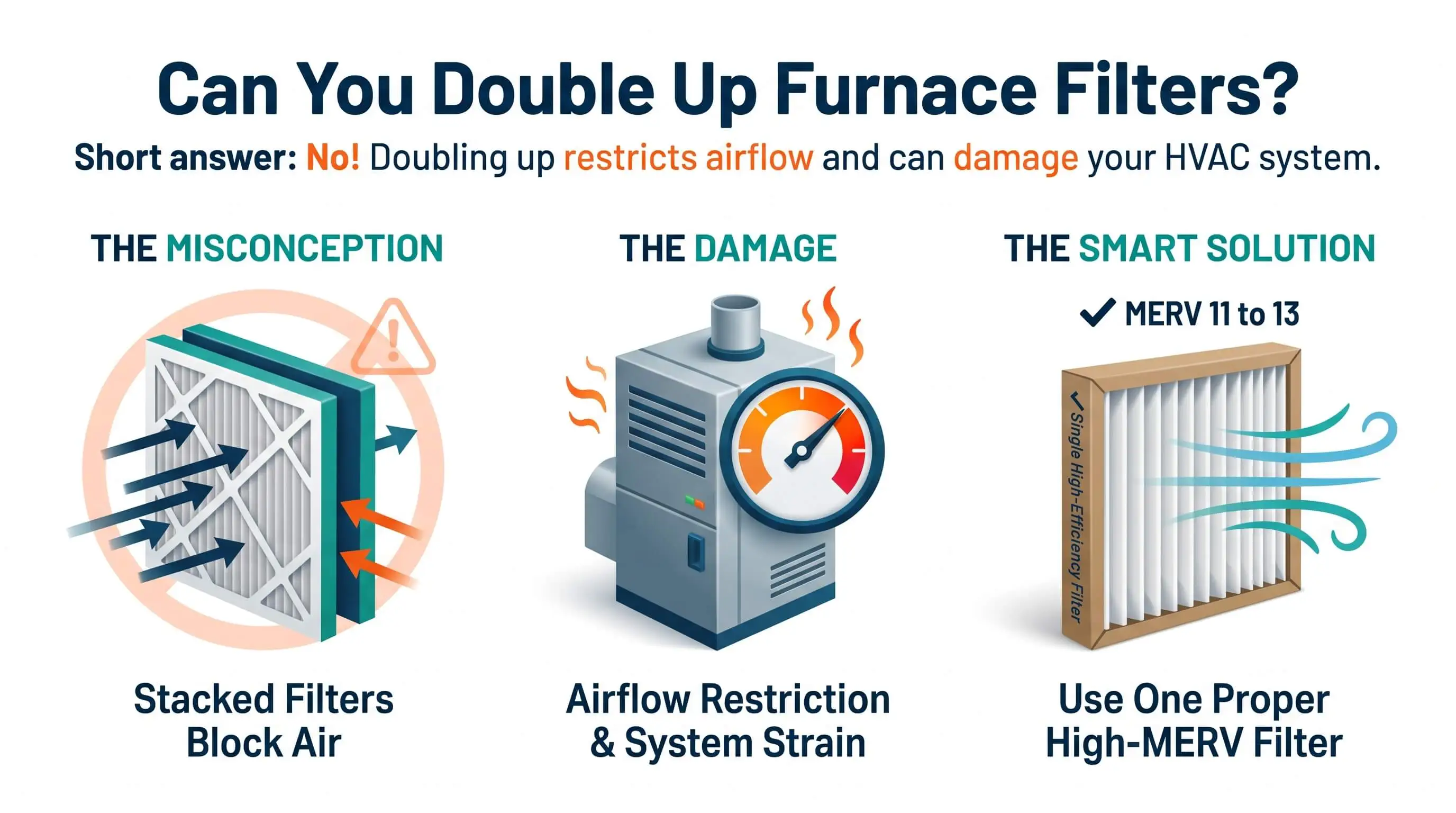
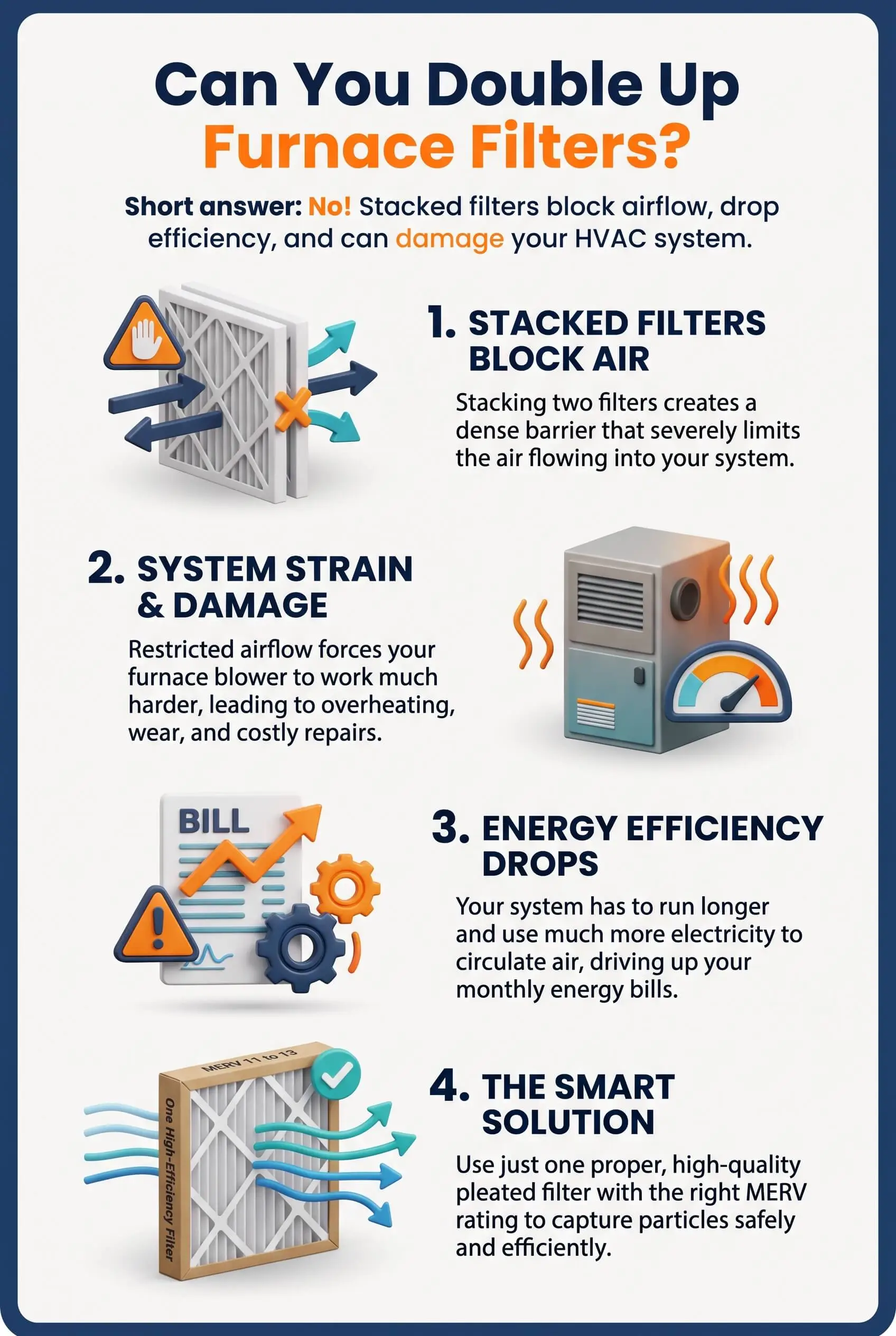
Don’t stack: Two filters add two pressure drops, which can strain your blower and overheat the heat exchanger.
Top Takeaways
Pressure stacks up: Two filters can push your blower past its rated limit.
Air finds the gaps: Doubled filters seal poorly and bow, so unfiltered air slips around them.
Your equipment pays: Restricted airflow strains motors and overheats heat exchangers.
Upgrade instead of stacking: One higher-MERV or deeper media filter outperforms two thin ones.
Measure before you guess: A technician's static pressure test shows exactly what your system can handle.
What Happens When You Stack Two Furnace Filters
Your furnace or air handler has a blower that pulls air out of your rooms, through the return duct and filter, then across the parts that heat or cool it. Manufacturers rate that blower for a set amount of resistance, which technicians call static pressure and measure in inches of water column. Think of it as blood pressure for your ductwork.
Pressure Drop Adds Up With Every Layer
Air loses a little pressure every time it passes through filter media. That loss is the pressure drop, and each added filter layer raises the pressure drop a bit more. Stack two, and the drops simply add together. One clean pleated filter may sit well inside your system's limits, while two often won't.
The margin is thinner than most homeowners expect. A trade guide on filter pressure drop explains that a gas furnace paired with an air conditioning coil should ideally spend only about 20% of its blower's rated external static pressure on the filter. Heat pump air handlers have more room, up to about half. A second filter can burn through that allowance before air reaches your ducts.
Why Airflow Matters More Than Capture Rate
Your system depends on a steady volume of air moving across hot or cold surfaces, and everything downstream suffers when that volume shrinks. This guide to air filter efficiency and airflow walks through the trade-off in more detail.
The Hidden Risks to Your Heating and Cooling System
Restricted airflow rarely breaks anything on day one. It wears your equipment down slowly, often until a repair bill arrives.
Blower motor strain: A variable-speed ECM motor ramps up to fight the resistance, drawing more power and running hotter. An older single-speed PSC motor just moves less air.
Heat exchanger overheating: Weak airflow traps heat inside the heat exchanger. The high-limit switch may cut the burners again and again, and repeated overheating can contribute to cracks.
Frozen evaporator coils: In summer, low airflow lets the indoor coil get too cold. Moisture freezes on its surface and your cooling capacity drops.
Higher energy bills: Longer cycles and a harder-working motor usually show up on your utility bill before you notice anything else.
Can Two Filters Make Your Air Dirtier?
They can. Most filter slots fit one filter of a specific depth. Squeeze in two and the frames rarely seal, while the stronger suction bows the media toward the blower. Both problems open gaps along the edges. Air always takes the easiest path.
Some air slips around the filters completely and carries dust straight into the system you meant to protect. The EPA advises choosing a filter that fits snugly, without bending or crushing it into place. ASHRAE, the engineering society behind filter test standards, makes the same point when it says a filter performs as rated only when it seals well.
Are There Times Two Filters Make Sense?
A few setups handle two filters well because someone designed or tested them for it.
Some media cabinets come with two slots, holding a coarse pre-filter in front of a finer main filter, and some manufacturers approve a specific pre-filter for their whole-home air cleaners.
An HVAC technician has measured static pressure with both filters installed and confirmed the reading stays within the blower's rating.
Unless your setup matches one of those, I'd leave the second filter on the shelf.
Better Ways to Improve Filtration With Furnace Filters
Cleaner air and a healthy system can go together. These upgrades get you there without choking your blower.
Step Up One MERV Level
Trading a basic fiberglass filter for a pleated MERV 8, 11 or 13 captures far more fine particles in a single layer. The EPA suggests a filter rated at least MERV 13, or as high as your system fan and filter slot can accommodate. Not sure yours can handle it? This look at MERV 13 in residential systems is a good place to start.
Switch to a Deeper Media Filter
If your system has a 4- or 5-inch media cabinet, or a technician can add one, a deep pleated filter gives you far more surface area. More surface area means less resistance and a longer life at the same efficiency rating.
Change Filters on Schedule
One clean filter will outperform two dirty ones every time. ENERGY STAR recommends checking your filter monthly and changing it at least every three months. Keeping a few furnace filters that fit your system in the hall closet makes that routine easy to keep. For a refresher, see this guide on how to change and replace your furnace filter.
Pro Tip: Before you slide the old filter out, snap a photo of the size and MERV rating printed on its frame. Your next order takes seconds.
Run the Fan Longer or Add a Portable Air Cleaner
Your filter only cleans air while the blower runs. Switching the thermostat fan from Auto to On during smoky weeks or heavy pollen season gives it more chances to catch particles. A portable HEPA air cleaner can cover a bedroom without adding load to your HVAC system.
Ask a Technician to Measure Static Pressure
A static pressure test takes a few minutes during a routine tune-up. That number shows exactly how much filter your system can handle.
Signs Your System Is Struggling With Airflow
Weak airflow coming out of supply vents
Whistling or hissing near return grilles
A furnace that shuts off before your home reaches temperature
Energy bills climbing while the weather holds steady
Ice forming on the refrigerant lines or indoor coil
A filter that looks bowed or pulled toward the blower
Spot any of these after adding a second filter? Pull it out, and call a licensed technician if symptoms linger.
“I've pulled doubled-up filters out of furnaces that were tripping the high-limit switch every few minutes. We went back to a single pleated filter, the static pressure reading dropped into the blower's rated range, and the short cycling stopped before I left the house.”
7 Essential Resources
ASHRAE: Filtration and Disinfection. The engineers behind filter test standards explain MERV ratings and filter sealing.
National Air Filtration Association: Residential Filtration. Industry guidance on choosing, installing and maintaining home HVAC filters.
U.S. EPA: Guide to Air Cleaners in the Home. Choosing a furnace filter, checking its fit and knowing when to call a technician.
National Center for Healthy Housing: Don't Fear Your Furnace. Practical furnace and filter care for owners and renters.
CDC: Improve Ventilation in Your Home. Quick checks on filter age and fit, plus fan settings.
HUD Healthy Homes: HVAC-Related Issues for Housing Rehabilitation. A conference presentation linking filter ratings to home health.
DOE Building America Solution Center: Filtration and Disinfection FAQ. A federal library entry pointing to ASHRAE's filtration Q&A.
3 Supporting Statistics
Swapping a dirty, clogged filter for a clean one can cut an air conditioner's energy use by 5% to 15%. Source: U.S. Department of Energy
Heating and cooling account for nearly half of the energy a home uses. Source: ENERGY STAR
When a better filter isn't an option, the EPA reports that switching the thermostat fan from Auto to On can cut indoor particle levels by as much as 24%. Source: EPA Wildfire Smoke Factsheet via AirNow
Final Thoughts and Opinion
Here's where I land. Stacking furnace filters answers the wrong question. Rather than asking how many layers fit in the slot, ask how much clean air your system can move through one well-matched filter.
For most homes, the biggest gains come from a pleated filter at the highest MERV rating your system tolerates, changed on a steady schedule. Want to go further? A deeper media filter or a portable air cleaner gets you there without gambling with your blower. Doubling up only looks thorough, and protecting your family, your home and your HVAC system starts with letting air move freely.
Frequently Asked Questions
Is it safe to use two furnace filters at once?
In most homes, no. Unless your system came with a two-slot rack or a technician has confirmed static pressure stays within the blower's rating, two filters can restrict airflow enough to wear out the motor and overheat the heat exchanger. Energy bills tend to climb as well. One properly sized filter is the safer call.
Will two MERV 8 filters equal one MERV 16?
No. MERV ratings don't add together. Two MERV 8 filters will catch a bit more than one, but they nearly double the resistance and often leak around the edges. A single higher-rated filter traps fine particles more effectively, and its maker tested it to perform as one unit.
Can I put a cheap filter in front of a pleated one?
Only when your equipment has a dedicated pre-filter slot. Taping or wedging a fiberglass filter in front of a pleated one still adds resistance, and it usually leaves gaps. If you want a pleated filter to last longer, changing it on schedule does more than shielding it ever will.
What MERV rating should I use instead of stacking?
Most homes do well somewhere between MERV 8 and MERV 13. The EPA suggests at least MERV 13 if your system can accommodate it. Homes dealing with allergies, pets or wildfire smoke usually get the most from the higher end, as long as airflow stays healthy.
How do I know if my furnace can handle a higher MERV filter?
Start with your owner's manual for filter guidance, then watch for airflow warning signs after any upgrade. For a definite answer, ask an HVAC technician to measure static pressure with the new filter in place and compare the reading to your blower's rating.
One Well-Matched Filter Beats Two
Cleaner air comes from one furnace filter matched to your system instead of two crowded into a slot built for one. Check your filter size and slot depth, choose the highest MERV rating your system handles comfortably, and keep fresh replacements coming on a steady schedule.