That’s what an air quality number looks like once it has finished with your house.
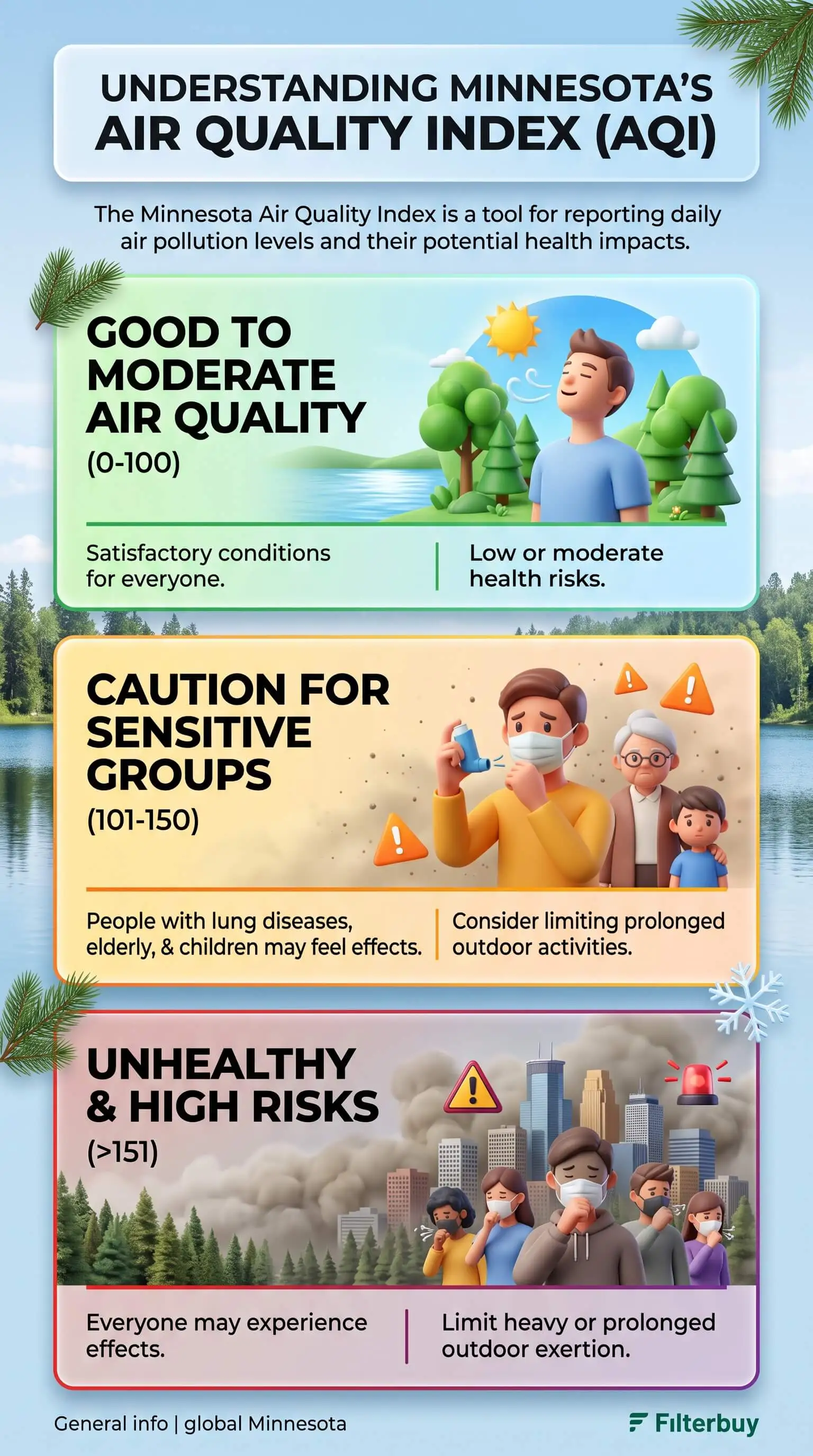
The index itself is simple. It runs 0 to 500, the EPA publishes it, and it tells you how clean the outdoor air is right now. At or below 100, most people can go about the day normally. Above 100, the air turns unhealthy for sensitive groups first, then for everyone else as the number keeps climbing.
Every guide out there tells you what that number means for your lungs. Almost none tell you what it means for the filter that’s supposed to be protecting them. In a state where Minnesota’s long winters brackets a summer smoke season blowing down from Canada, that filter is the most controllable piece of the whole equation, and it’s the part I want to cover.
TL;DR Quick Answers
Air Quality Minnesota
Minnesota air is good most of the year and turns unhealthy in bursts. Two things drive those bursts: wildfire smoke drifting down from Canada in summer, and ground-level ozone on hot, stagnant afternoons. A statewide figure tells you almost nothing, since Duluth can sit in orange while Rochester stays green on the same day.
Most days: 0 to 50, Good. Outside smoke season, that's the normal reading.
Alert threshold: Above 100 is unhealthy for sensitive groups. Minnesota alerts usually land in the 101 to 150 orange band.
Season: May through October, heaviest in mid-summer.
Smoke vs. ozone: PM2.5 from smoke runs around the clock and lasts days. Ozone peaks mid-afternoon and clears after dark.
The part almost nobody checks: a stretch above 100 loads your furnace filter in weeks instead of months. Inspect it weekly during an alert.
Read the monitor closest to you, then go look at your filter. Read the monitor closest to you, then go look at your filter and make sure your HVAC system installation is moving air through it properly.
Top Takeaways
The AQI runs 0 to 500. At or below 100 is generally fine. Above 100 the air turns unhealthy for sensitive groups first, then for everyone.
Read your local monitor, never a statewide average. Duluth and Rochester can sit an entire category apart on the same afternoon.
Check which pollutant is driving the number. Smoke lingers around the clock, while ozone peaks in the afternoon and eases after dark.
Smoke loads a filter far faster than dust does, and a loaded filter often looks fine from across the room.
Treat a stretch of readings above 100 as your cue to inspect weekly and replace early.
Buy the replacement before smoke season starts. That one habit does more than any upgrade.
What the Numbers Actually Mean
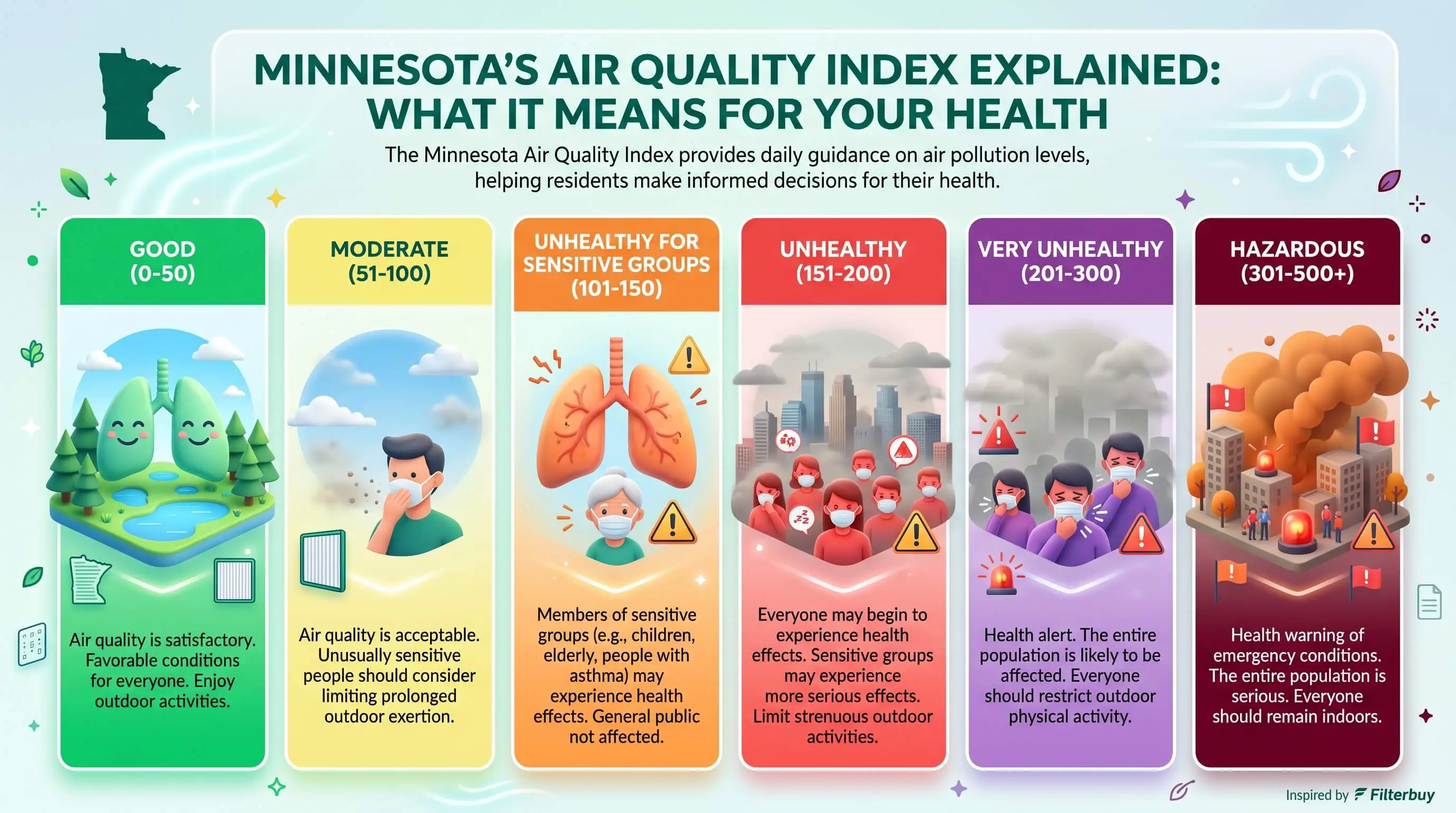
Six color-coded categories run the system. Read each one as an instruction rather than a grade.
0 to 50, Good, green. Clean air. Take the long walk, open the windows, let the kids stay out until dinner.
51 to 100, Moderate, yellow. Fine for nearly everyone. A small number of unusually sensitive people might notice something on a long, hard effort.
101 to 150, Unhealthy for Sensitive Groups, orange. Where Minnesota lands most often during smoke season. Kids, older adults, and anyone with asthma or a heart condition should ease off outdoors.
151 to 200, Unhealthy, red. Everyone starts to feel it. Move the workout inside.
201 to 300, Very Unhealthy, purple. A health alert. Stay in, keep the house sealed, and filter the air you already have.
301 and above, Hazardous, maroon. Emergency conditions.
One detail catches people out every year. The EPA tightened the fine-particle end of the scale in May 2024, so the top of the Good range now sits at a lower PM2.5 concentration than it used to. If you’re seeing more yellow than you remember, that’s often the ruler changing rather than the air.
Read Your Local Number, Not the State Average
A statewide average is close to useless in a state this wide. Smoke sliding down from Manitoba can park Duluth and the Iron Range in orange while the Twin Cities and Rochester sit comfortably in green, and the map can flip by the next afternoon. The only number worth acting on comes from the monitor nearest you.
That’s why I keep a live air quality index map for Minnesota bookmarked on my phone instead of trusting a headline. Find your city, read the number and the color, then check which pollutant is driving it. Most people skip that last step. It’s the one that changes what you should do next when improving home air quality.
Smoke Day or Ozone Day?
These two behave nothing alike, and telling them apart tells you whether to wait out an afternoon or seal up for two days.
Fine particles, or PM2.5, usually carried in on wildfire smoke. It arrives at any hour and hangs around for days. There’s no safe window. Keep the house closed and the system running until the number comes down.
Ground-level ozone. It builds through hot, sunny, stagnant afternoons and eases after sunset, so early morning and evening are your clean windows. Plan the run or the yard work around them.
What a High-AQI Week Does to Your Filter
A bad-air week costs you money in a way most homeowners never trace back to the source.
Wildfire smoke isn’t house dust. Household dust sits in the larger size ranges and gets caught near the surface of the pleats, where you can actually see it building up. Smoke particles are far smaller, they arrive in enormous numbers, and they pack down into the depth of the media rather than resting on top of it. A filter can be seriously loaded well before it looks bad from the doorway. I’ve pulled filters that read as light gray at a glance and were choking the system.
Loaded media raises resistance. The blower fights harder for the same airflow, the motor runs hotter, and the volume of air actually getting cleaned drops at the exact moment you need it climbing. A clogged high-efficiency filter protects you less than a fresh mid-range one, which is why upgrading your rating without also changing it more often works against you.
Adjusting Your Replacement Schedule
Stop guessing and let the air outside trigger the change.
On a normal Minnesota stretch, hold your usual cadence and inspect every 30 days.
Once your local reading crosses 100 for more than a day or two, check weekly. Pull the filter out and hold it up to a light rather than eyeballing it in the slot.
Through a heavy or extended smoke event, plan on swapping well ahead of schedule. A few weeks is normal here, not premature.
Buy the next filter before smoke season, not during it. The worst spot to be in is an alert day, a loaded filter, and an empty closet.
On rating, the EPA points homeowners toward MERV 11, or the highest rating your system can handle, because that’s where filters start capturing a meaningful share of the fine particles smoke drives indoors. Confirm your equipment can move air through it before you jump two levels. If you’re unsure, have a technician check static pressure.
What to Do on an Alert Day
Close the windows and doors and keep them closed until the number drops.
Set the thermostat fan to On rather than Auto, so the system filters continuously instead of only during heating or cooling cycles.
Recirculate indoor air rather than pulling in outside air, and add a portable air cleaner in whichever room you use most.
Check the filter sooner than you think you need to.
Check on anyone in the house with asthma, COPD, or a heart condition, and follow the guidance from state and federal health agencies rather than a rule of thumb.
“What surprised me was the speed. I used to treat a smoke week as an inconvenience and assume the filter would sort itself out on the normal schedule. Then I started pulling them early and weighing what came out. A filter that had been in for under a month during a heavy stretch looked and felt like one that had run a full season. Now I treat a run of readings above 100 the way I treat a hard freeze warning. It is a scheduled event, and the single best move is having the replacement sitting in the closet before the haze shows up.”
7 Essential Resources
These are the seven I keep bookmarked. All free, all kept current, each one useful for a different piece of the problem.
1. AirNow, Fires and Your Health. The EPA’s own guidance on what smoke does to you and how to respond as levels climb, straight from the agency that sets the index. Start here. airnow.gov
2. Minnesota Department of Health, Wildfire Smoke. State-specific guidance on who faces the most risk and what to do at each level, written in plain language. health.state.mn.us
3. CDC, Wildfires and Your Safety. The best single source on protecting children, pregnant people, and anyone managing a chronic condition before, during, and after a smoke event. cdc.gov
4. Minnesota DNR, Fire Danger and Burning Restrictions. Updated daily. The fastest way to spot local fire activity before it becomes your air quality problem. dnr.state.mn.us
5. ASHRAE, Wildfire Response Resources. The engineering body behind the MERV scale, including its 2024 guidance on protecting occupants from smoke. Worth reading if you want the technical basis rather than somebody’s summary of it. ashrae.org
6. National Institute of Environmental Health Sciences, Indoor Air Quality. The research side of why indoor air matters as much as it does, with none of the marketing. niehs.nih.gov
7. CPSC, The Inside Story: A Guide to Indoor Air Quality. An older guide that still holds up as the clearest plain-English walkthrough of what floats around your house and where it comes from. cpsc.gov
Supporting Statistics
723,418 Minnesota children breathe unhealthy air. The Minneapolis and St. Paul metro ranked 39th worst in the country for short-term particle pollution and earned an F grade, based on an average of 4.5 unhealthy days per year in Hennepin County. Source: American Lung Association, State of the Air 2026
12 to 16 days of wildfire smoke are forecast for summer 2026. State meteorologists also expect four to six days when ozone may reach levels unhealthy for sensitive groups, slightly above the historical average, with the highest ozone risk in the Twin Cities suburbs and southeastern Minnesota. Source: Minnesota Pollution Control Agency
Americans spend roughly 90 percent of their time indoors. Concentrations of some pollutants run two to five times higher inside than in typical outdoor air, which is why the number on the outdoor map only tells you half the story. Source: U.S. Environmental Protection Agency
With wildfire smoke, unhealthy particle days, and most Americans spending the majority of their time indoors, MERV 11 filters can be a practical part of reducing airborne particles and supporting cleaner indoor air.
Final Thoughts
My honest opinion, after enough smoke seasons to see the pattern, is that folks treat the index like a weather report when it works far better as a maintenance signal.
You check the number, decide whether to go for a run, and move on. Almost nobody connects it to the piece of equipment doing the actual work of cleaning the air they will breathe for the next sixteen hours. That disconnect is the most common mistake I see, and the easiest one to fix. Using high quality filters is part of that equation. The reading tells you two separate things at once, and most people only ever hear the first.
None of this takes special equipment or expertise, either. Checking a number takes ten seconds. Holding a filter up to a light takes about the same. The households that ride out a smoke week comfortably are almost never the ones with the most expensive systems. They’re the ones who looked early and had a spare on the shelf.
Frequently Asked Questions
Is the Air Quality Index Bad in Minnesota Today?
Check the live map for your own city rather than a statewide figure. Minnesota air is usually good, but wildfire smoke or summer ozone can push readings into unhealthy ranges within a few hours. If your local number sits above 100, sensitive groups should scale back outdoors. Above 150, everyone should move activity inside, where options such as air ionizer installation may be considered as part of a broader indoor air quality strategy.
What AQI Level Is Unhealthy in Minnesota?
Anything above 100 counts as unhealthy for sensitive groups, meaning children, older adults, and people with asthma or heart and lung conditions. Above 150 the air is unhealthy for everyone. Above 200 triggers a health alert, and above 300 is treated as emergency conditions. Minnesota smoke events most often land in the 101 to 150 orange band.
Does Wildfire Smoke Shorten the Life of a Furnace Filter?
Yes, and by more than most people expect. Smoke particles are much smaller and far more numerous than household dust, so they pack into the depth of the filter media instead of collecting on the surface. A filter that would normally run two to three months can be functionally spent in a few weeks during a heavy stretch, and it will often still look acceptable at a glance.
How Often Should I Change My Filter During an Air Quality Alert?
Inspect weekly once your local reading has been above 100 for more than a day or two, and replace well ahead of your normal schedule during a heavy or extended event. Pull the filter out and hold it against a light source rather than judging it in the slot. If light barely passes through the media, it’s done.
What MERV Rating Do I Need for Wildfire Smoke?
The EPA points homeowners to MERV 13, or the highest rating the system can handle, because that’s where filters begin capturing a meaningful share of fine particles. Confirm your equipment can move air through it first. A restrictive filter in an underpowered system cuts airflow enough that less air gets cleaned overall, which defeats the purpose.
Your Next Two Steps
Do both of these today, before the next hazy afternoon catches you out. Pull up the current reading for your own city and note the number along with the dominant pollutant. Then walk over to your return vent, take the filter out, and hold it up to a light. Five minutes, and you will know almost everything about the air you’re going to breathe tonight.
If that filter is loaded, order the replacement now rather than during the next alert. And if you have your own hard-won trick for getting through a Minnesota smoke week, put it in the comments. I learn as much from readers on this subject as I do from anywhere else.