Run a finger across your return grille in late October and you'll probably come away with a tuft of undercoat. Choosing the right air filter for your home helps trap the fine dander behind most dog allergies while maintaining proper airflow. When someone in the house has allergies or asthma, or two or more heavy shedders share the space, consider a higher-efficiency air filter, as long as your equipment can handle it.
Your air filter rating tells you how small a particle it can stop. When I dug into the published test data, the rating mattered less than most dog owners assume, and the change schedule mattered more.
TL;DR Quick Answers
air filter
An air filter is the pleated panel in your HVAC return that traps dust, pollen, pet dander, and other particles before they recirculate. Its MERV rating shows how small a particle it stops. For most homes, MERV 8 to 13 works, and changing it on time matters more than chasing the highest number.
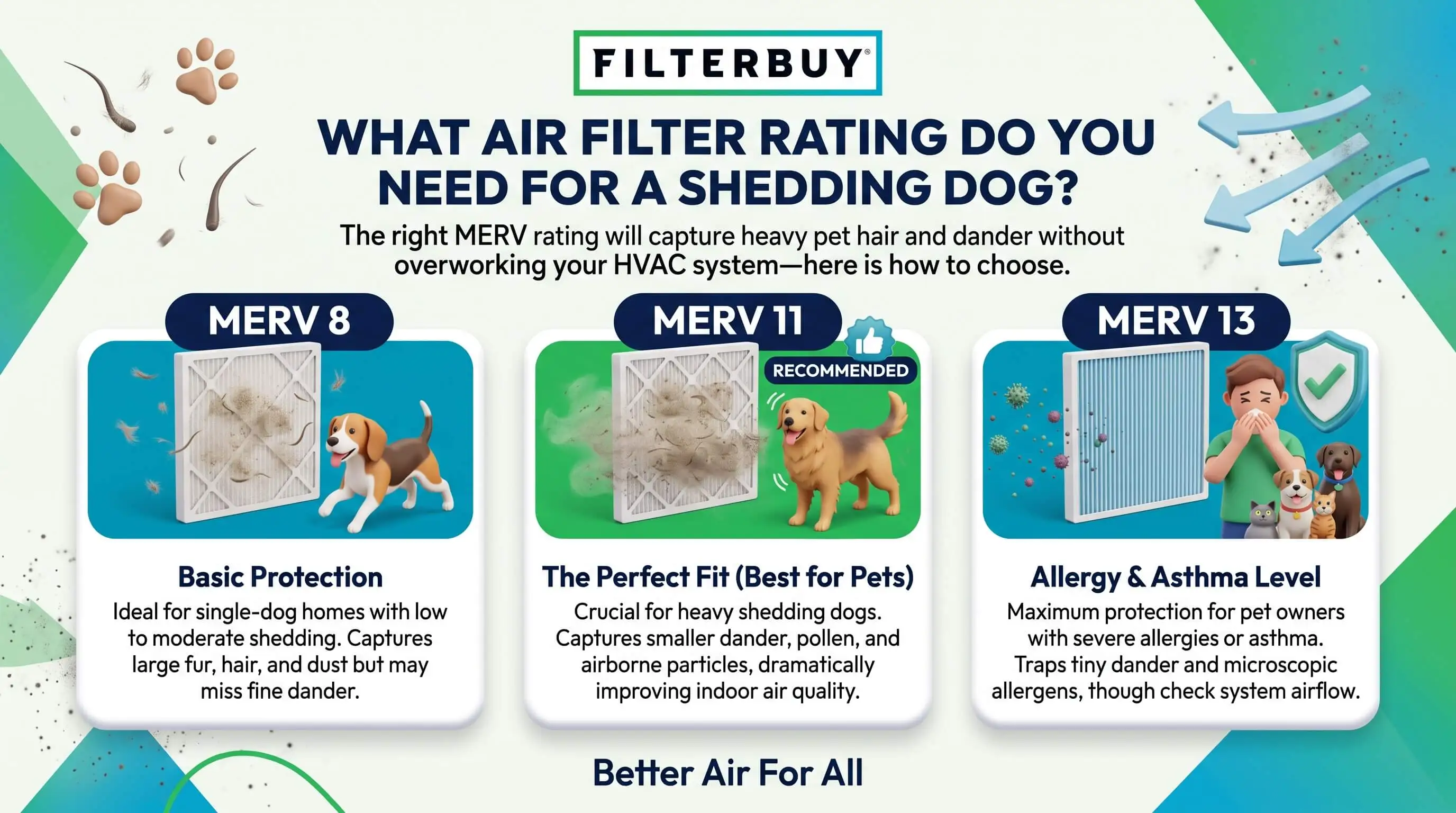
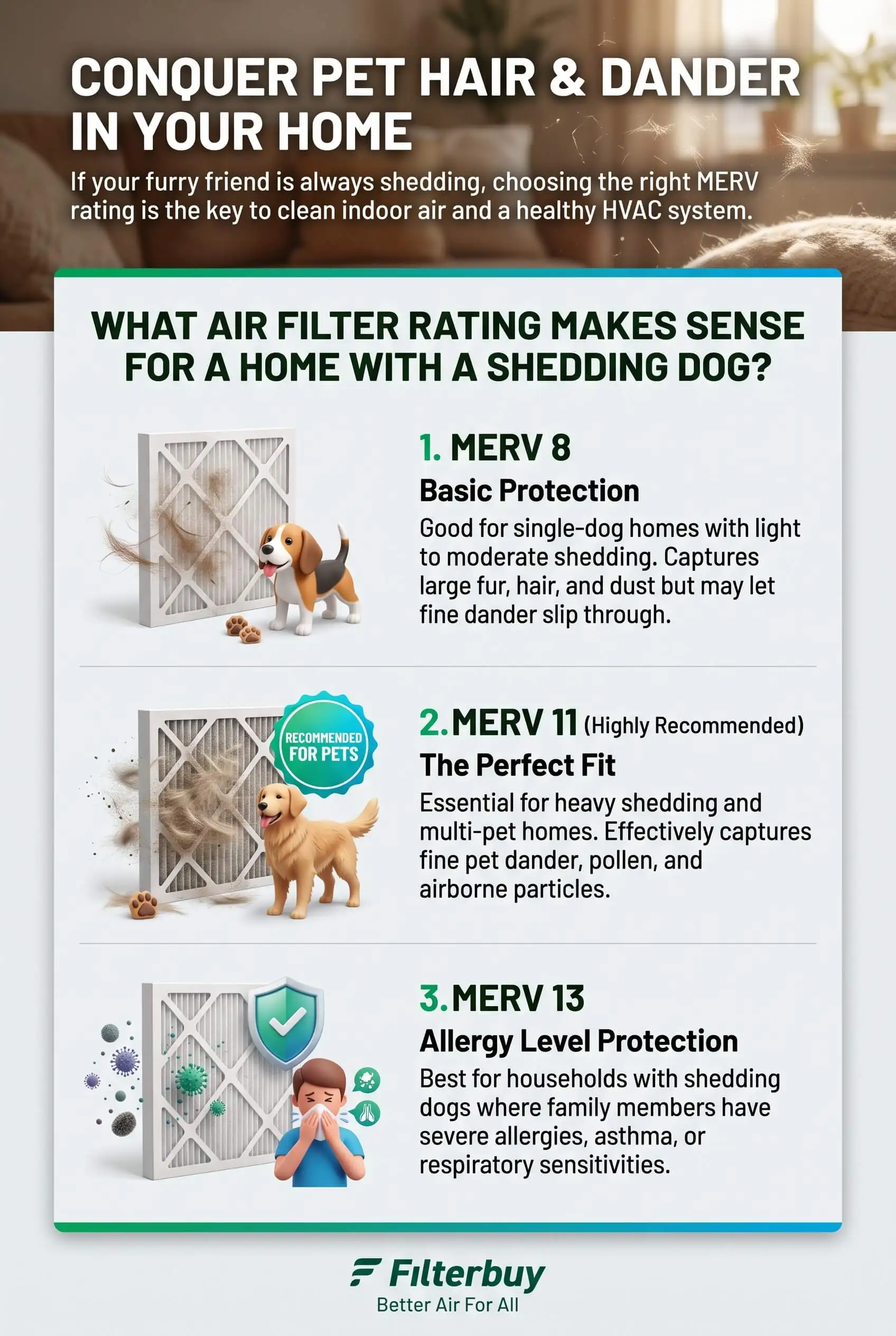
Pick the lowest rating that solves your problem: MERV 8 for everyday dust, MERV 11 for pet dander, MERV 13 for allergy or asthma homes.
Pets change the schedule more than the rating: a shedding dog can load a filter in 30 to 45 days instead of 90.
Depth beats a bigger number: a 4-inch filter carries a higher rating with less airflow resistance than a 1-inch filter.
Odor needs carbon: MERV ratings only cover particles, so smells call for an activated carbon layer.
Fit comes first: order the size printed on your current filter’s frame so air can’t slip around the edges.
Top Takeaways
MERV 11 is the right air filter rating for most homes with one shedding dog.
Dog hair is easy to catch, so the rating decision comes down to dander and the pollen your dog carries in.
Move to MERV 13 for allergy or asthma homes once you confirm your system can handle the airflow.
A 4-inch filter can carry a higher rating with less resistance than a 1-inch filter.
Shedding season changes how often you replace the filter far more than which rating you pick.
Odor needs activated carbon, since MERV ratings only cover particles.
Dog Hair and Dog Dander Are Two Different Filter Problems
Fur gets the blame because you can see it. The EPA notes that MERV ratings measure particles between 0.3 and 10 microns, and dog hair is far bigger than anything in that range, so nearly any pleated home air filter stops it.
Dander is the problem you can't see. Those microscopic, jagged flecks of skin stay airborne longer than most allergens. The Asthma and Allergy Foundation of America points out that people react to proteins in a dog's dander, saliva, and urine rather than the hair, and that fur picks up pollen, dust mites, and mold too. Every afternoon your dog spends in the yard, outdoors riding back in on its coat.
Matching the Air Filter Rating to Your Dog Household
Choose the lowest rating that solves the problem your home actually has. For most dog owners, that's MERV 11, and this MERV 11 breakdown explains why it fits so many systems.
One Moderate Shedder and No Allergies: MERV 8 to MERV 11
MERV 8 captures at least 70 percent of particles in the 3 to 10 micron range, which covers hair and heavier dust. MERV 11 adds at least 65 percent capture between 1 and 3 microns, right where dander starts to matter. Torn between them? Go with MERV 11.
Double-Coated Breeds or Two or More Dogs: MERV 11
German Shepherds, Huskies, Golden Retrievers, and plenty of other double-coated breeds drop their undercoat in heavy bursts every spring and fall. MERV 11 keeps up with that dander without adding much resistance. Your change schedule is what needs to move.
Allergies or Asthma in the Home: MERV 13 If Your System Allows It
For allergy homes, the American College of Allergy, Asthma and Immunology recommends disposable MERV 11 to 13 filters as the most cost-efficient whole-house option. MERV 13 catches at least half of the finest particles, from 0.3 to 1 micron. A so-called hypoallergenic breed won't spare you this step, since AAFA notes that no dog is truly non-allergic. Confirm your equipment can handle the denser media first, and check whether MERV 13 is too restrictive for your setup.
Why a Higher Rating Is Not Automatically Better for Airflow
Every air filter pushes back on the air moving through it. HVAC pros call that resistance static pressure, and a filter that's too dense for your system turns it into a cost. Department of Energy research found the filter can account for 20 to 50 percent of a system's total pressure drop. Most homes run best at about 0.5 inches of water column or lower.
Your blower decides what happens next. An older PSC motor simply moves less air as resistance climbs, so some rooms run warm and others run cold. A variable-speed ECM motor fights to hold airflow, which means it draws more power and wears out faster.
Most guides skip filter depth, and it often matters more than the number on the frame. Deeper pleats spread the air across more media, which lowers resistance. The same DOE guide compares three MERV 7 filters, and the 1-inch version measured 0.20 inches of water column while the 4-inch version dropped to 0.12. With a 4-inch slot, you can usually run a higher rating and put less strain on the system than a 1-inch filter would. Before you upgrade to higher-rated filters from MERV 8 pleated furnace air filters, check the pressure-drop figure on the filter frame and your equipment manual.
Shedding Season Changes the Schedule More Than the Rating
The 60 to 90 days printed on most packaging assumes nobody in the house sheds. ENERGY STAR recommends checking your filter every month, and the Department of Energy says homes with fur-bearing pets need more frequent attention. Here's where I'd start.
One light or moderate shedder: replace every 60 days
One heavy shedder or two or more dogs: replace every 30 to 45 days
During a spring or fall coat blow: inspect every two weeks
Pull the filter and hold it up to a light. Once you can't see through the pleats, it's done, whatever the calendar says.
What an Air Filter Won't Fix on Its Own
Particle ratings do nothing for dog odor, because odor is a gas. That job belongs to a filter with an activated carbon layer. Settled dander needs a hand too. Brush your dog outside, keep the bedrooms dog-free, and vacuum with a HEPA-equipped machine, steps both ACAAI and the American Lung Association recommend. You're the one protecting your family, your home, and your HVAC system, and your filter does its best work with that kind of backup.
"After inspecting thousands of returned filters from dog homes, we see the same thing every spring and fall. Undercoat fluff mats across the leading edge of the pleats within about two weeks, and that mat drives pressure drop up while the media behind it is still mostly clean. So the filter starts starving the blower well before it's finished catching dander."
7 Essential Resources
American-Made Replacement Air Filters in MERV 8, 11, and 13
Pleated filters in standard and custom sizes, with MERV 8, 11, 13, and carbon odor options to match the rating from this guide to your exact slot.
Source: https://filterbuy.com/
What a MERV Rating Actually Measures
The EPA lays out capture efficiency for every MERV level across three particle-size ranges.
Source: https://www.epa.gov/indoor-air-quality-iaq/what-merv-rating
How Filter Depth and Pressure Drop Affect Your System
The Department of Energy's Building America guide explains static pressure, and why deeper pleats let you run a higher rating with less strain.
Source: https://basc.pnnl.gov/resource-guides/high-merv-filters
What Allergists Recommend for Whole-House Filtration
ACAAI explains why disposable MERV 11 to 13 filters are the cost-efficient pick for allergy homes and why cheap fiberglass filters fall short.
Source: https://acaai.org/allergies/management-treatment/living-with-allergies/air-filters/
Why Pet Allergens Are So Common
NIEHS covers how cat and dog allergens trigger symptoms and how they can make asthma harder to control.
Source: https://www.niehs.nih.gov/health/topics/agents/allergens/pets
How Pet Dander Moves Through Your Home
The American Lung Association explains why dander lingers in the air longer than other allergens and which habits cut your exposure.
Source: https://www.lung.org/clean-air/indoor-air/indoor-air-pollutants/pet-dander
A Simple Monthly HVAC Maintenance Checklist
ENERGY STAR puts a monthly filter check right alongside the rest of your seasonal maintenance.
Source: https://www.energystar.gov/saveathome/heating-cooling/maintenance-checklist
3 Supporting Statistics
Dogs Live in About 43 Percent of U.S. Households
The AVMA reports that 42.6 percent of U.S. households own a dog, roughly 87.3 million dogs nationwide in its 2025 data.
Source: https://www.avma.org/resources-tools/reports-statistics/us-pet-ownership-statistics
Cat and Dog Allergies Affect 10 to 20 Percent of People Worldwide
AAFA reports that allergies to cats and dogs affect 10 to 20 percent of the world's population. When someone in your home falls in that group, MERV 13 earns its place, provided your system can move air through it.
Source: https://aafa.org/allergies/types-of-allergies/pet-dog-cat-allergies/
A Clean Filter Can Cut Air Conditioner Energy Use by 5 to 15 Percent
The Department of Energy says swapping a dirty, clogged filter for a clean one can lower an air conditioner's energy use by 5 to 15 percent. Filters load faster in a dog home, so staying on schedule protects your air and your utility bill at the same time.
Source: https://www.energy.gov/energysaver/maintaining-your-air-conditioner
Final Thoughts and Opinion
I think most people ask this question backwards. They want to know how high a rating they can get away with, when the better question is how low a rating will solve the problem. For a typical shedding dog in a home without allergies, that answer is MERV 11.
Where I'd push harder is the calendar. During shedding season, a MERV 11 filter changed every 30 days will do more for your air than a MERV 13 left in for three months, because a matted filter stops filtering and starts restricting. Want more capture without more strain? Look at a deeper filter before you reach for a higher number. Build your routine around the coat, not the package.
Frequently Asked Questions
Is MERV 13 too restrictive for a home with dogs?
Not always. Plenty of systems run MERV 13 without trouble, especially with a 4-inch filter slot, though older equipment with a 1-inch slot can lose airflow. Check your equipment manual, then feel the airflow at your registers after you switch.
Does a higher MERV air filter catch more dog hair?
You won't notice a difference. Dog hair is far larger than the 0.3 to 10 micron particles MERV ratings measure, so nearly every pleated filter stops it. A higher rating pays off on dander, pollen, and the other fine particles your dog brings inside.
How often should I change my air filter during shedding season?
Check it every two weeks while your dog is blowing the coat, and replace it when you can't see light through the pleats. The rest of the year, heavy shedders or multi-dog homes do well with fresh high quality filters every 30 to 45 days, and one moderate shedder can go about 60.
Do hypoallergenic dog breeds still need a higher-rated filter?
Usually, yes. AAFA notes that no dog is truly non-allergic, because the allergens come from dander, saliva, and urine instead of hair. A low-shedding breed may load your filter more slowly, but an allergy household still benefits from MERV 11 to 13.
Will an air filter remove dog odor?
A standard pleated filter won't, because odor is a gas rather than a particle. Look for an air filter with an activated carbon layer.
Give Your Shedding Dog the Air Filter Rating It Calls For
Start with MERV 11 in most dog homes, and move up to MERV 13 when allergies are part of the picture and your system can push air through it. Check the filter once a month and every two weeks while your dog sheds hard. With the top air filters, your home's air will stay as clean as your floors on vacuum day.