If your home collects dust faster than most, your filter needs to come out every 30 to 45 days — not the 60 to 90 days printed on the box. After manufacturing filters for over a decade and working with more than two million households, we've learned that dusty homes don't follow standard schedules, and treating them like they do is one of the most common — and costly — mistakes homeowners make.
High-dust environments load filters faster than manufacturers account for. Pets, older carpet, heavy foot traffic, nearby construction — any of these can cut a filter's effective lifespan in half. When a filter clogs ahead of schedule, airflow drops, your HVAC works harder, and the system meant to clean your air starts recirculating the problem instead.
Here, you'll find out exactly how to read your home's dust signals, choose the right change interval, and select the right air filter home solution and MERV rating that protects your family without restricting your system — because in our experience, the right filter on the wrong schedule protects no one.
TL;DR Quick Answers
air filter home
A home air filter is a replaceable media panel installed in your HVAC system that captures airborne particles — dust, pollen, pet dander, mold spores, and fine particulate matter — before they circulate through your living space. Here is what every homeowner needs to know:
What it does: Traps airborne particles to protect both your indoor air quality and your HVAC system's internal components
Where it goes: Inside the return air vent or air handler of your home's heating and cooling system
How often to change it: Every 30 to 45 days in a dusty home — every 60 to 90 days in an average household with no pets and low foot traffic
What rating to choose: MERV 8 to MERV 11 for most homes — high enough to capture the particles that matter, without restricting airflow
What happens if you skip changes: Reduced airflow, higher energy bills, accelerated HVAC wear, and degraded indoor air quality
The rule that never changes: A fresh filter at a lower MERV rating outperforms a clogged filter at a higher one — every time
After manufacturing filters for over a decade and serving more than two million households, the single most important thing we can tell you is this: the right filter on the wrong schedule protects no one. Know your home's dust conditions, set your change interval accordingly, and treat the filter as the indicator it is — not the afterthought it's usually treated as.
Top Takeaways
Dusty homes need a 30- to 45-day filter change schedule — not the 90-day interval on the box. High-dust conditions that shorten filter life include:
Pets and shedding
Older carpet and upholstered furniture
High foot traffic and large households
Proximity to construction or unpaved roads
A clogged filter doesn't just stop working — it actively makes things worse. Once saturated, filter media stops capturing new particles and starts recirculating what it's already holding. The compounding effects arrive fast:
Airflow drops
HVAC run time increases
Energy bills climb
Indoor air quality declines
Fresh filter media beats a high-rated filter every time. A MERV 11 changed every 30 days outperforms a MERV 13 left in place for 90 days — without exception. Remember:
Filtration efficiency means nothing when media is saturated
Change frequency and filter rating work together
Neither one compensates for a failure in the other
Every overdue filter change costs your HVAC system money. ENERGY STAR reports a dirty filter reduces system efficiency by 5 to 15 percent. In a dusty home this means:
Efficiency loss arrives ahead of the 90-day calendar mark
Costs compound across every billing cycle
The impact hits the single largest energy expense in the home
Treat your filter as a home air quality indicator — not a set-and-forget item. The homeowners who get the best results share three habits:
Check the filter at 20 to 30 days — not at 90
Learn what the home's actual dust load looks like over time
Adjust the change interval based on what the filter shows — not what the box says
Why Dusty Homes Need a Different Filter Schedule
Standard filter change intervals assume an average household — moderate foot traffic, no pets, and reasonably clean indoor air. Dusty homes don't fit that profile. Dust, dander, debris, and airborne particles accumulate on filter media faster than manufacturers anticipate when they print a 60- to 90-day recommendation on the packaging.
In our experience manufacturing filters for homes across every region of the country, the homes that struggle most with air quality aren't always the ones you'd expect. A newer home near active construction can out-dust an older one. A single large dog can load a filter faster than a four-person household with hardwood floors. The condition of your home — not a calendar — is the most reliable guide to when your filter needs to change.
What Counts as a "Dusty" Home
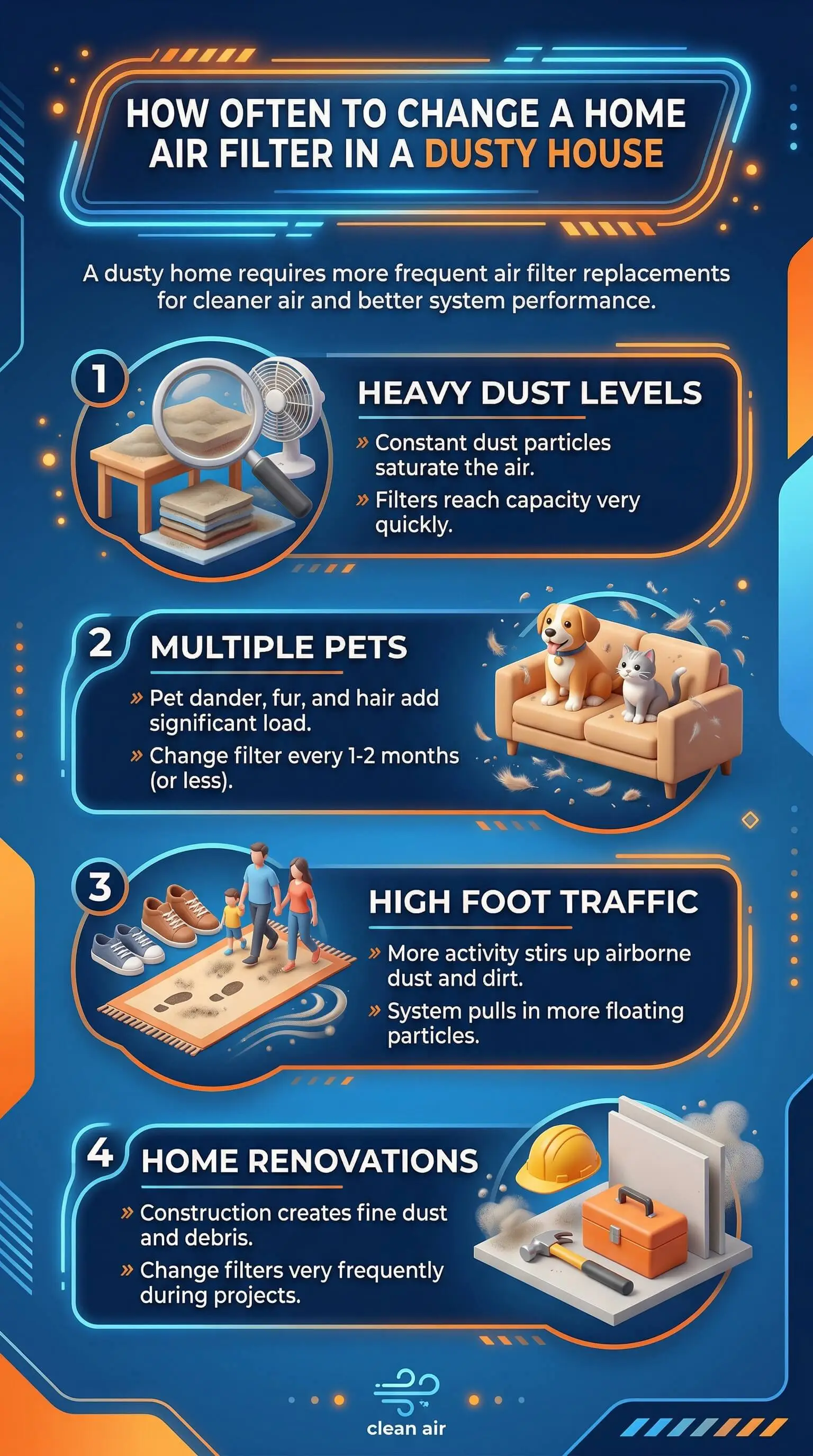
Before adjusting your change schedule, it helps to know what qualifies. A dusty home typically involves one or more of the following conditions:
One or more pets that shed fur or dander
Older carpet, rugs, or upholstered furniture that releases particles over time
High foot traffic from large households or frequent guests
Proximity to construction, unpaved roads, or agricultural land
Recent renovation work, including drywall, sanding, or painting
Forced-air HVAC systems with older, leaky ductwork
If two or more of these apply to your home, a 30-day change interval is the right starting point.
How Often to Change Your Filter in a Dusty House
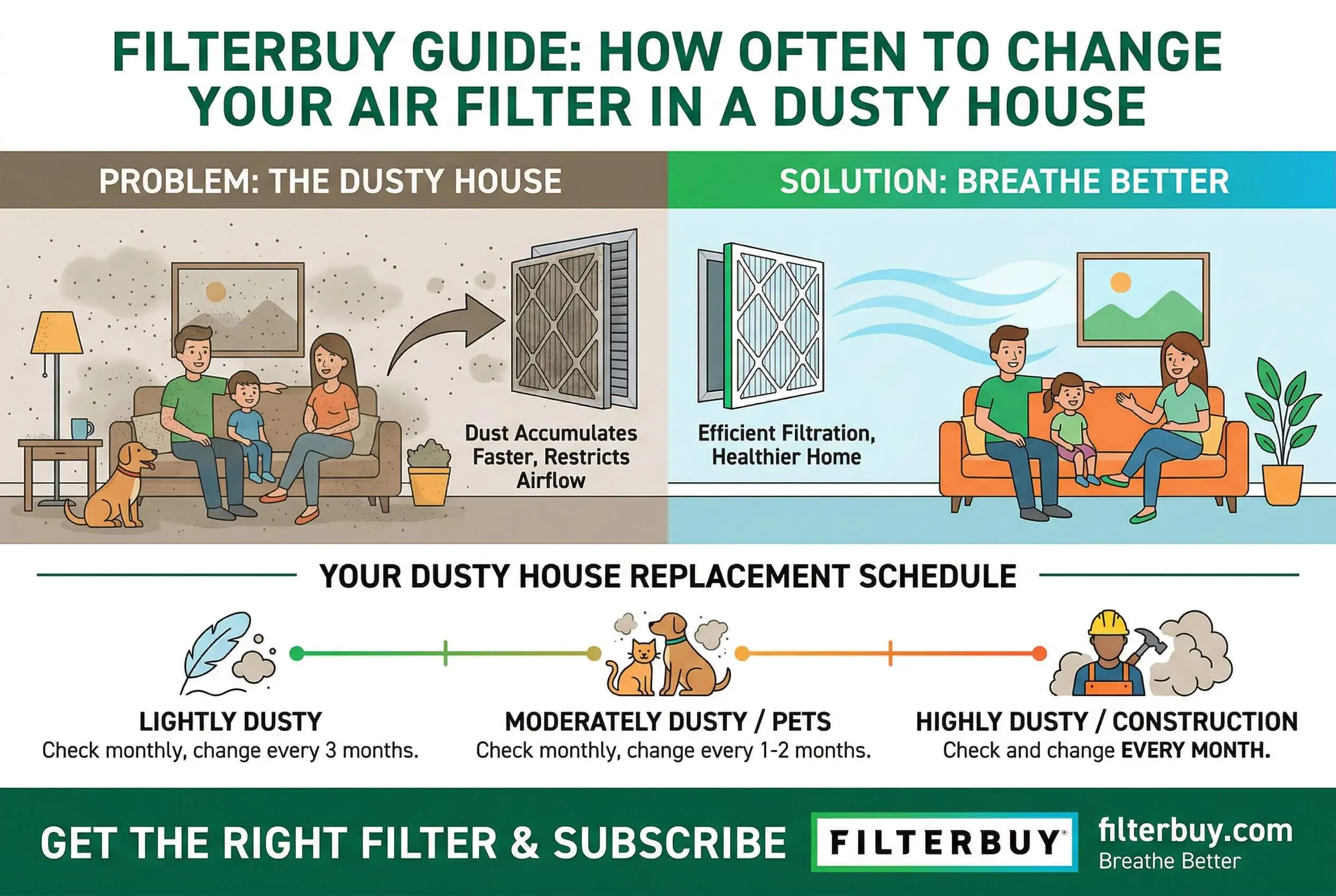
For most dusty households, a 30- to 45-day filter change schedule is the practical standard. Here's how to narrow it down further based on your specific conditions:
Every 30 days: Multiple pets, high foot traffic, or recent renovation work
Every 45 days: One pet or a single elevated dust factor with no other compounding conditions
Every 60 days: Mild dust concerns with no pets and a smaller household
These aren't arbitrary intervals. When we analyze filter returns and customer feedback across millions of orders, the homes that report the most HVAC issues — reduced airflow, higher energy bills, increased allergy symptoms — are consistently the ones running 90-day filters in 30-day conditions.
What Happens When You Wait Too Long
A clogged filter doesn't just stop filtering — it actively creates problems. As dust accumulates, filter media restricts airflow. Your HVAC system compensates by running longer cycles to maintain temperature, which drives up energy costs and accelerates wear on the blower motor and heat exchanger. In severe cases, a loaded filter can cause the system to overheat or freeze, depending on the season.
Beyond system stress, a saturated filter loses its ability to capture new particles. Dust that would otherwise be trapped passes through and circulates back into your living space — the exact opposite of what the filter is there to do.
Choosing the Right MERV Rating for a Dusty Home
Filter efficiency matters as much as change frequency. For dusty homes, a MERV 8 to MERV 11 filter offers the right balance of particle capture and airflow protection.
MERV 8: Captures dust, pollen, mold spores, and pet dander. A reliable baseline for most dusty households with standard HVAC systems.
MERV 11: Captures finer particles including dust mite debris and some smoke particles. A strong choice for homes with allergy sufferers or multiple pets.
MERV 13+: Maximum filtration, but requires a compatible HVAC system. Restricts airflow in systems not designed to handle higher resistance, which can cause more harm than good.
When in doubt, a MERV 11 filter changed every 30 days outperforms a MERV 13 filter left in place for 90 days. Fresh filter media always beats a high-rated filter that's past its effective life.
How to Tell Your Filter Needs to Come Out Early
Your home will give you signals before the calendar does. Watch for these signs that your filter has reached its limit ahead of schedule:
Visible gray or brown buildup on the filter surface when you pull it out
Increased dust settling on furniture and surfaces between cleanings
Reduced airflow from vents, particularly in rooms farthest from the air handler
Your HVAC system running longer or more frequently than usual
Allergy or asthma symptoms worsening indoors without an obvious external cause
If any of these appear before your scheduled change date, pull the filter and replace it immediately. In a dusty home, the filter is working harder than it looks — and waiting costs you more than the price of a replacement.
"Most homeowners are surprised to learn that filter change intervals have nothing to do with time and everything to do with conditions. After manufacturing filters for over a decade and working with more than two million households, we've seen the same pattern repeat itself: a family in a dusty home follows the 90-day recommendation, their HVAC starts struggling, and they assume the system is failing — when the filter was the problem all along. In a dusty house, 30 days isn't being overly cautious. It's just being accurate. The filter doesn't know what month it is. It only knows how much it's holding."
Essential Resources
What Every Homeowner Should Know About Home Air Filters
After manufacturing filters for over a decade and working with more than two million households, we've learned that the homeowners who get the best results aren't just buying the right filter — they're making informed decisions backed by reliable information. The resources below are sourced exclusively from government agencies and peer-reviewed research institutions, because when it comes to your family's air, only the most trustworthy sources belong on this list.
Understand How Home Air Filters and Air Cleaners Actually Work
Most homeowners don't realize how much difference filter selection makes until something goes wrong. The EPA's primary consumer guide cuts through the confusion — explaining exactly how HVAC filters and portable air cleaners function, what performance metrics actually matter for residential use, and how to match the right filtration option to your home's specific needs. https://www.epa.gov/indoor-air-quality-iaq/guide-air-cleaners-home
Decode MERV Ratings Before You Buy Your Next Filter
In our experience, MERV ratings are one of the most misunderstood numbers in home maintenance — and getting them wrong costs homeowners more than they expect. This EPA resource demystifies the rating scale, clarifies what particle sizes each range actually captures, and helps you choose the right efficiency level without unknowingly starving your HVAC system of the airflow it needs. https://www.epa.gov/indoor-air-quality-iaq/what-merv-rating
Identify the Hidden Pollutants Circulating in Your Home Right Now
One of the most important things we can do as a filter manufacturer is help you see what's invisible. The EPA's indoor air quality guide examines the most common household pollutants source by source — dust, dander, mold spores, volatile compounds, and more — and outlines proven strategies for reducing their concentration in the spaces where your family spends the most time. https://www.epa.gov/indoor-air-quality-iaq/inside-story-guide-indoor-air-quality
See Why Indoor Air Can Be More Polluted Than the Air Outside
This is one of the facts that surprises our customers most: indoor pollutant concentrations can run two to five times higher than outdoor levels. This EPA report documents exactly why that happens, which household members face the greatest risk, and what the long-term health consequences of inadequate home air filtration actually look like. https://www.epa.gov/report-environment/indoor-air-quality
Match Your Filter to Your HVAC System Using ASHRAE Standards
Choosing a high-efficiency filter that your HVAC system can't handle is one of the most common — and most avoidable — mistakes we see. ASHRAE's filtration FAQ provides the technical guidance homeowners and professionals need to understand filter performance standards, confirm MERV compatibility with residential equipment, and upgrade filtration without creating the airflow resistance that quietly drives up energy costs and system wear. https://www.ashrae.org/technical-resources/filtration-and-disinfection-faq
Know the Minimum MERV Rating Your Home Should Never Fall Below
Serving over two million households has shown us that many homeowners are running filters well below the efficiency level their home actually requires. This ASHRAE technical document outlines the minimum recommended MERV values for residential use, addresses airflow resistance at higher efficiency ratings, and clarifies exactly when a conversation with an HVAC professional is the right next step before upgrading your filter. https://www.ashrae.org/File%20Library/Technical%20Resources/Technical%20FAQs/TC-02.04-FAQ-02.pdf
Understand What Household Dust Is Actually Doing to Your Family's Lungs
We manufacture filters because we believe protecting your family's air is one of the most important things a homeowner can do — and this peer-reviewed NIH research review shows exactly why that conviction is warranted. It documents the respiratory health effects of common indoor air pollutants — including dust mites, pet dander, and fine particulate matter — with particular relevance for households where allergy or asthma sufferers are present. https://pmc.ncbi.nlm.nih.gov/articles/PMC7665158/
Supporting Statistics
After manufacturing filters for over a decade and working with more than two million households, we've learned that the homeowners who struggle most with air quality aren't always living in the most polluted areas. They're often the ones unaware of what's happening inside their own home. The statistics below — drawn exclusively from U.S. government agencies — put numbers to what we see play out in homes across the country every day.
The Air Inside Your Home Is Likely More Polluted Than the Air Outside
The U.S. Environmental Protection Agency reports that Americans spend approximately 90 percent of their time indoors — where pollutant concentrations are often two to five times higher than outdoor air. That finding surprises almost everyone who hears it. It surprises them even more when they learn who is most exposed:
Young children
Older adults
Anyone living with a respiratory or cardiovascular condition
These are the same populations that spend the most time indoors. In a dusty home, the best furnace filters for home help maintain cleaner air, capture more unwanted particles, and support a fresher, healthier indoor environment when replaced at the right time.
Source: U.S. Environmental Protection Agency — Indoor Air Quality Report on the Environment https://www.epa.gov/report-environment/indoor-air-quality
A Clogged Filter Can Cut Your HVAC System's Efficiency by Up to 15 Percent
ENERGY STAR reports that a dirty air filter can reduce HVAC efficiency by 5 to 15 percent. In dusty homes, the problem runs deeper than the percentage alone suggests:
Filters reach their loading limit well before the 90-day calendar mark
Efficiency loss arrives early and compounds quietly
The energy bill reflects the problem long before anyone thinks to check the filter
Serving millions of households has shown us that the gap between a filter's actual service life and its assumed service life is one of the most consistent — and most preventable — sources of unnecessary HVAC cost.
Source: ENERGY STAR — Heat and Cool Efficiently https://www.energystar.gov/saveathome/heating-cooling
Heating and Cooling Account for Nearly Half of All Residential Energy Use
ENERGY STAR identifies heating and cooling as the single largest energy expense in a typical American home — nearly half of total residential energy consumption. We think about that figure often when considering what a clogged filter actually costs a household. The impact in a dusty home compounds quickly:
A filter overdue by 30 days restricts airflow and drives up run time
Longer run cycles increase wear on the blower motor and heat exchanger
Every additional day past the change date adds cost to an already heavy energy draw
In a dusty home, filter maintenance isn't a minor housekeeping task. It's one of the most direct levers a homeowner has over their single largest monthly energy expense.
Source: ENERGY STAR — Heat and Cool Efficiently https://www.energystar.gov/saveathome/heating-cooling
Final Thoughts
Most air filter advice stops at the calendar. Change it every 90 days, the packaging says. For an average home with average conditions, that's a reasonable starting point, but the best air filters can do even more when paired with the right replacement schedule. But after manufacturing filters for over a decade and working with more than two million households, we've come to believe the 90-day rule is one of the most quietly damaging myths in home maintenance.
Dusty homes don't follow average schedules. They never have.
The gap between what a filter is assumed to handle and what it actually encounters in a high-dust environment is where most of the damage happens. Not dramatic, sudden damage — the slow, compounding kind:
A slightly higher energy bill one month
Reduced airflow the next
An HVAC service call a few months later
A system replacement years ahead of schedule
Our Honest Opinion After Years in This Industry
A filter change interval isn't a product recommendation. It's a household diagnosis. The right schedule depends on factors no manufacturer can account for when printing a number on a box:
Number of pets and shedding frequency
Flooring type — carpet loads filters faster than hardwood
Household foot traffic and number of occupants
Proximity to construction, unpaved roads, or agricultural land
The Rule That Never Changes in a Dusty Home
A MERV 11 filter changed every 30 days will outperform a MERV 13 filter left in place for 90 days — every time, without exception. Fresh media captures particles. Saturated media recirculates them. That distinction matters more than the rating on the packaging.
What the Homeowners Who Get the Best Results Have in Common
The households we've seen achieve the cleanest air, lowest energy bills, and fewest HVAC repairs all share one habit. They treat their filter as a living indicator of what's happening in their home — not a set-and-forget maintenance item. In practice, that means:
Checking the filter at 20 to 30 days, not waiting for the 90-day mark
Learning what their home's actual dust load looks like over time
Adjusting the change interval based on what the filter shows — not what the box says
That attentiveness doesn't require expensive equipment or professional help. It requires understanding that your home has its own rhythm — and that the filter is one of the few places where that rhythm becomes visible.
That's what we mean when we say we're obsessed with better air. Not just better products. Better outcomes — for every family that trusts us to help them get it right.
FAQ on Air Filter Home
Q: How often should I change my home air filter if I have a dusty house?
A: Change your filter every 30 to 45 days — not the 60 to 90 days on the box. Standard intervals assume average conditions. Most dusty homes don't qualify as average. After working with more than two million households, here is what we recommend:
Every 30 days: Multiple pets, recent renovation work, or high foot traffic
Every 45 days: One pet or a single elevated dust factor with no compounding conditions
Every 60 days: Mild dust concerns, no pets, and a smaller household
Pull the filter in 20 to 30 days. If it looks gray or brown, your home needs a shorter schedule than the box will ever tell you.
Q: What is the best MERV rating for an air filter in a dusty home?
A: For most dusty households, MERV 8 to MERV 11 delivers the right balance of particle capture and airflow protection. After manufacturing filters for homes across every region of the country, here is how we break it down:
MERV 8: Captures dust, pollen, mold spores, and pet dander. The dependable baseline for most dusty homes with standard HVAC systems
MERV 11: Captures finer particles including dust mite debris and some smoke. The stronger choice for homes with allergy sufferers or multiple pets
MERV 13+: Maximum filtration. Only appropriate for HVAC systems specifically designed to handle higher airflow resistance
One rule that holds true across millions of households:
A MERV 11 changed every 30 days outperforms a MERV 13 left in for 90 days — every time
Rating and frequency work together
In a dusty home, frequency wins
Q: What are the signs that my home air filter needs to be changed early?
A: The filter signals its limit before the calendar does. In a dusty home, act immediately when you notice any of the following:
Visible gray or brown buildup covering the filter surface
More dust settling on furniture between regular cleanings
Reduced airflow from vents — especially in rooms farthest from the air handler
HVAC system running longer or more frequently than usual
Allergy or asthma symptoms worsening indoors without an obvious cause
Energy bills rising without a clear seasonal explanation
In a high-dust household these signals can appear well before the 30-day mark. When they do:
Pull the filter immediately
Inspect the surface for visible loading
Replace it — do not wait for the scheduled change date
Waiting costs far more than the price of a new filter.
Q: What qualifies a home as a dusty house when it comes to air filter changes?
A: Serving over two million households has shown us that dusty homes come in more varieties than most homeowners expect. Two important things we've learned:
A newer home near active construction can out-dust an older one
A single large dog can load a filter faster than a four-person household with hardwood floors
The most common high-dust conditions we see include:
One or more pets that shed fur or dander
Older carpet, rugs, or heavily upholstered furniture
High foot traffic from large households or frequent guests
Proximity to construction sites, unpaved roads, or agricultural land
Recent renovation work including drywall, sanding, or painting
Forced-air HVAC systems with older or leaky ductwork
If two or more of these apply:
Start at a 30-day change interval
Check the filter at 20 days on the first cycle
Adjust based on what the filter shows — not what the packaging says
The more conditions that stack, the shorter your effective filter life becomes.
Q: What happens to my HVAC system if I don't change my air filter often enough in a dusty home?
A: After a decade of manufacturing filters and analyzing what goes wrong in homes that skip changes, we can confirm the consequences follow a predictable sequence — and they compound fast:
Filter media saturates ahead of schedule as dust accumulates faster than the manufacturer anticipated
Airflow drops as the clogged filter restricts the volume of air the system can move
HVAC run time increases as the system runs longer cycles to reach the thermostat setting
Energy consumption rises — ENERGY STAR reports a dirty filter reduces system efficiency by 5 to 15 percent
Component wear accelerates on the blower motor and heat exchanger from sustained overwork
Indoor air quality declines as the saturated filter recirculates particles instead of capturing them
What surprises most homeowners is how quickly this plays out in a dusty home. Here is what ignoring the schedule actually costs:
A few dollars saved on a delayed filter change
Hundreds of dollars lost to energy waste
Thousands of dollars risked in premature system repairs
No single maintenance habit delivers a higher return than staying current on filter changes — especially in a home that demands a shorter schedule than average.
Ready to Find the Right Air Filter for Your Dusty Home?
If your home collects dust faster than most, your filter change schedule should reflect that — and so should the filter you're putting in. Shop Filterbuy's full selection of MERV-rated home air filters, available in over 600 sizes including custom dimensions, and start protecting your home with a filtration routine built around what your household actually needs.