The right 20x25x1 HVAC home air filter can change what happens to those particles before they recirculate. An air filter is your system’s first and only line of particle defense. In a cat household, it works harder than it was built for — and a filter mismatched to that load fails faster and more quietly than most people catch.
We’ve manufactured filters for over a decade and fielded enough calls from cat owners to know exactly where the mismatch happens. What follows is the specific guidance that fixes it.
TL;DR Quick Answers
20x25x1 HVAC home air filter
The 20x25x1 is one of the most common residential HVAC filter sizes — 20 inches wide, 25 inches tall, 1 inch thick — fitting most standard return air grilles and furnace filter slots. MERV 8 handles everyday dust and pollen in a pet-free home. MERV 11 captures pet dander and finer allergen particles without restricting airflow. Replace every 60–90 days in a typical household, or every 30–45 days if cats or dogs are present. Confirm actual dimensions before ordering — nominal and actual sizes differ by up to half an inch.
Top Takeaways
Cat hair and dander load a 20x25x1 filter significantly faster than standard household dust, often cutting a 60-day service life to 30 days or less in a heavy-shedding home
MERV 11 is the right starting point for most cat households: strong dander capture, low airflow restriction, compatible with nearly all residential HVAC systems
MERV 13 suits multi-cat homes and allergy households, but requires confirming the system’s static pressure tolerance before you switch
A 30–45 day replacement schedule is more realistic than the standard 60–90 day guideline in any home with a cat
Visible hair on vent covers and dust resettling quickly between cleanings are early indicators the current filter isn’t keeping up with the home’s actual pet load
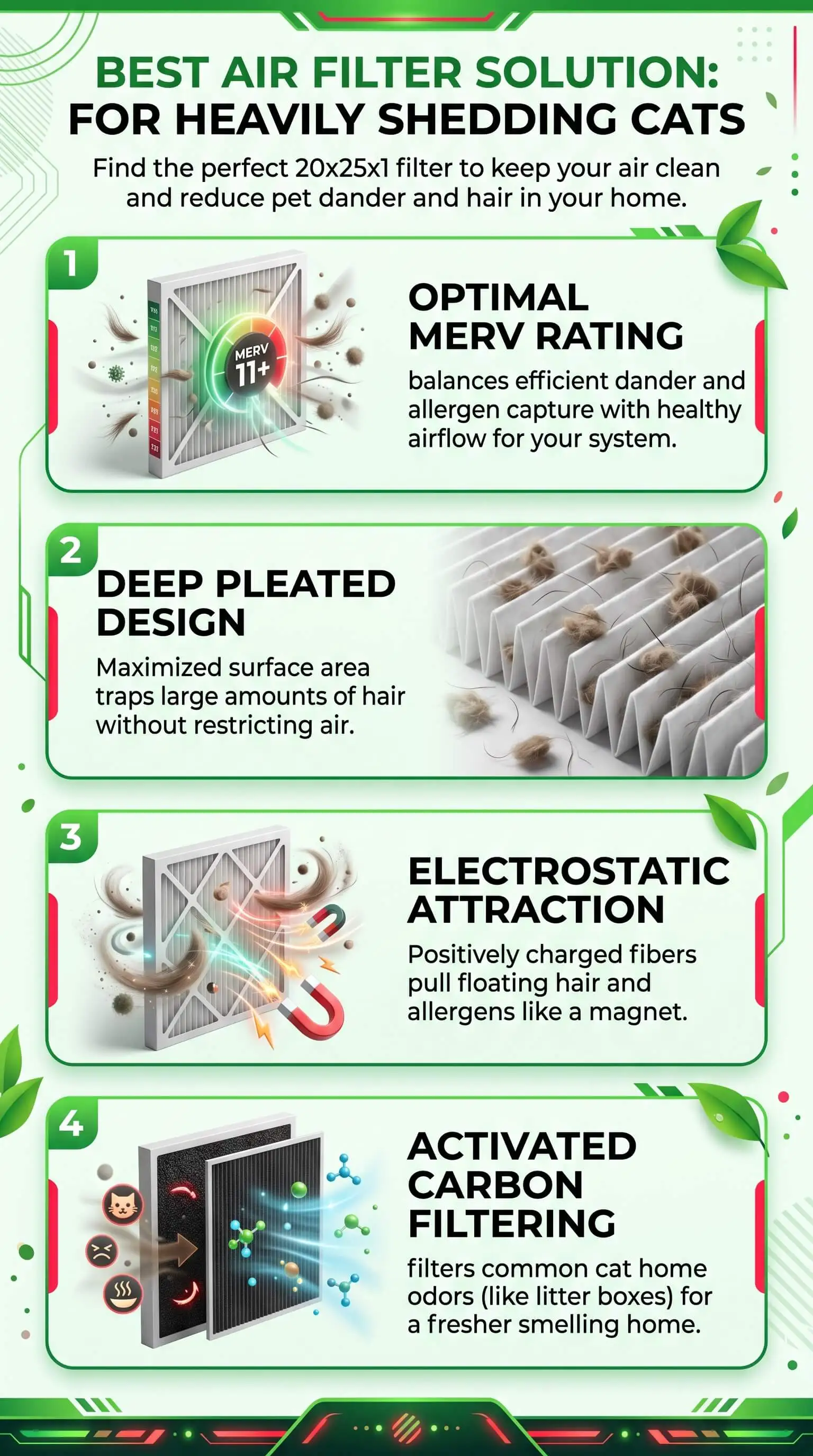
Filter construction matters as much as MERV rating. Pleat geometry and media density determine how much particulate the filter can hold before airflow drops and allergens push through
A MERV 11 filter changed on time consistently outperforms a MERV 13 filter left in place too long
What Cat Hair Actually Does to Your HVAC Filter
Standard household dust is relatively inert. It settles across the filter face at a predictable rate, distributes with some uniformity, and loads the media slowly. Cat hair doesn’t work that way at all.
Hair fibers mat across the outer pleat faces and block airflow before the media behind them gets a chance to capture anything smaller. Cat dander — the microscopic dead skin flakes that carry the proteins most people react to — is far smaller and lighter than hair. It stays suspended in the air for hours, penetrates deep into filter media, and loads the substrate faster than standard dust from the same home.
What you’re left with is a filter that looks done in three weeks when it should last sixty days. That visible loading also hides a second problem: fine allergen particles slipping through the outer hair mat while the filter was still catching bulk debris. Choosing the right MERV rating and staying proactive with air filter replacement addresses both problems at once.
Which MERV Rating Works Best for Homes With Cats
The goal is a filter that intercepts dander particles in the range where they do the most harm, without restricting airflow enough to stress the blower motor. Cat dander generally falls in the 5–10 micron size range. MERV 11 filters capture particles as small as 1.0–3.0 microns at 65% minimum efficiency and particles in the 3.0–10 micron range at 85% or better. That covers the range where cat allergens operate.
For most single-cat households, MERV 11 is the right answer. It delivers meaningful dander capture, maintains reasonable airflow in nearly all residential HVAC systems, and doesn’t require the static-pressure math that MERV 13 sometimes demands.
Homes with multiple cats, a heavy shedder, or someone managing allergies should consider MERV 13. At that rating, capture efficiency for particles in the 1.0 -- 3.0 micron range reaches 85% or better, covering the smallest cat allergen particles that stay airborne longest. The trade-off is real: MERV 13 restricts more airflow than MERV 11. Before making the switch, pull your system’s documentation and confirm the maximum static pressure the blower is rated for. Most residential systems built in the last fifteen years handle MERV 13 without issue. Older equipment and smaller blower motors often don’t.
Browse the full range of 20x25x1 air filters to compare MERV 11 and MERV 13 options side by side.
How Often to Change a 20x25x1 Filter With Cats in the Home
The 60–90 day replacement guideline assumes a baseline particulate load that cat hair disrupts immediately. Use household pet load as your guide instead. Here’s where to start:
Single cat, no allergies in the home: Every 60 days
Two to three cats, or one heavy shedder: Every 30–45 days
Three or more cats, or allergy sufferers in the household: Every 20–30 days
These are starting points. Carpeted homes, high-traffic areas, and systems running continuously through summer and winter all add particulate load beyond what cats alone put in. Check the filter face visually for two weeks. If the media is matted or hair accumulation is visible across the pleats, replace it now. Don’t wait for the calendar.
Signs Your Current Filter Isn’t Keeping Up With Cat Shedding
Some filters fail slowly and quietly. Cat households usually give you early warnings before the problem gets expensive:
Cat hair visible on supply vent covers or in the louvers of return grilles
A gray or tan mat forming on the filter face within the first two weeks after a change
Reduced airflow from supply registers — run your hand across one and compare it to how it felt right after the last change
Dust resettling on surfaces within days of cleaning, despite regular vacuuming
Pet odors drifting from supply vents during a heating or cooling cycle
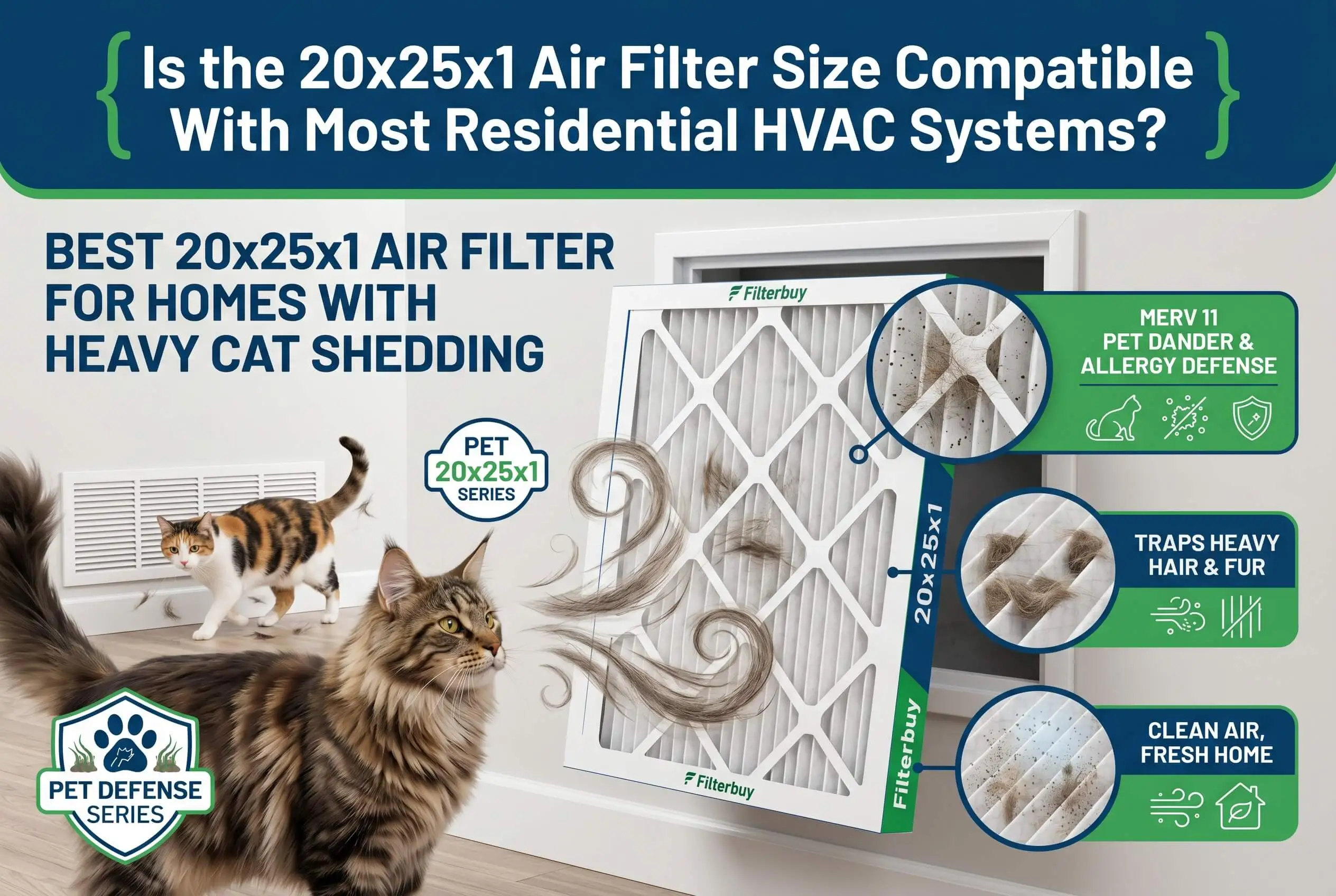
“What most homeowners don’t realize is that cat hair and dander don’t load a filter the way dust does. The hair mats across the outer pleat faces fast — sometimes within days in a heavy-shedding household — while the smaller dander particles push through the media and recirculate. Our MERV 11 filters are built with a pleat geometry and media density specifically chosen to intercept both: the hair captures on the outer face while the finer allergen particles bind in the inner media layers. That’s why MERV rating alone doesn’t tell the whole story. Filter construction matters as much as the number.”
7 Essential Resources
Why Indoor Pet Allergens Trigger More Than Sneezing
Cat dander and saliva carry proteins that a sensitized immune system identifies as a threat. The EPA explains how biological contaminants — including animal dander and cat saliva — enter the home through normal daily activity, become airborne during vacuuming and movement, and build up in HVAC systems that circulate them through every room.
Source: https://www.epa.gov/indoor-air-quality-iaq/biological-pollutants-impact-indoor-air-quality
How MERV Ratings Translate to Real-World Cat Allergen Reduction
EPA residential air cleaner research documents predicted reductions in cat allergen concentrations by filter MERV level. A MERV 7 filter yields roughly 20% reduction in small-particle cat allergens. MERV 11 and above achieve substantially higher capture efficiency, with meaningful improvement in the particle size ranges where cat dander operates and diminishing returns beyond MERV 13.
Source: https://www.epa.gov/sites/default/files/2014-08/documents/residential_air_cleaning_devices.pdf
The Standard That Defines What Your MERV Rating Actually Means
ASHRAE Standard 52.2 establishes the test methodology behind every MERV rating on the market. This ASHRAE technical FAQ explains how the ratings are structured, what they measure, and why most residential systems ship from the manufacturer with filters rated MERV 1–4 — and what that gap means for cat owners who need real allergen capture.
Source: https://www.ashrae.org/File%20Library/Technical%20Resources/Technical%20FAQs/TC-02.04-FAQ-02.pdf
Pet Dander as a Persistent Indoor Air Threat
The American Lung Association reports that nearly 62% of U.S. households have pets, with over 161 million cats and dogs combined. Their pet dander resource covers how dander moves through indoor air, why allergen levels persist in rooms the animal doesn’t enter, and which filtration and cleaning steps make a measurable difference in exposure.
Source: https://www.lung.org/clean-air/indoor-air/indoor-air-pollutants/pet-dander
Why 10–20% of the Global Population Reacts to Cats and Dogs
AAFA’s cat and dog allergy resource explains the biology of pet allergen sensitization: why people react to the protein in dander rather than the hair itself, how symptoms range from mild nasal congestion to asthma attacks, and why cat allergen is uniquely persistent. It’s difficult to clear from indoor environments even months after a cat has been removed from the home.
Source: https://aafa.org/allergies/types-of-allergies/pet-dog-cat-allergies/
Indoor Air Pollution Ranks Among the Top Five Environmental Health Risks
The EPA’s guide to air cleaners in the home places indoor air pollution among the nation’s top five environmental health risks and explains why source control combined with proper filtration, particularly filters in the MERV 7–13 range, is the most effective residential approach to reducing airborne allergens without sacrificing airflow.
Source: https://www.epa.gov/sites/default/files/2014-07/documents/aircleaners.pdf
How Animal Allergens Become Airborne Respiratory Risks
NIOSH documents how animal dander, hair, and body proteins become potent airborne allergens and why inhalation is the most common exposure pathway. The publication focuses on occupational animal handlers, but the allergen biology applies directly to anyone living with cats, and the filtration guidance translates to home HVAC systems.
Source: https://www.cdc.gov/niosh/docs/97-116/default.html
3 Supporting Statistics
Cats and Dogs Live in the Majority of American Homes
Pet hair is the most consistent filter performance complaint we hear — across regions, climates, and system types — and the numbers tell you why. The American Lung Association reports that nearly 62% of U.S. households have pets, with over 161 million cats and dogs combined. At that scale, allergen-producing animals are a baseline reality in most American homes, and the 20x25x1 slot in the return grille becomes one of the most consequential maintenance decisions a homeowner makes — especially because MERV 8 filters offer a dependable, balanced solution for capturing everyday pet-related particles while supporting healthy airflow.
Source: https://www.lung.org/clean-air/indoor-air/indoor-air-pollutants/pet-dander
Pet Allergies Affect an Estimated 10–20% of the Global Population
Most customers who call us about upgrading their MERV rating aren’t doing it out of curiosity. Someone in the household is already symptomatic. That tracks precisely with the data: AAFA confirms that allergies to cats and dogs affect an estimated 10–20% of the world’s population, making pet allergens one of the most common indoor sensitization triggers globally — and one of the most manageable with the right filter choice.
Source: https://aafa.org/allergies/types-of-allergies/pet-dog-cat-allergies/
Medium-Efficiency Filters Are Nearly as Effective as HEPA for Most Indoor Particles
EPA residential air cleaner research found that filters rated MERV 7–13 perform nearly as well as true HEPA filters at reducing concentrations of most indoor particles linked to health effects, including cat allergens. A properly selected MERV 11 or MERV 13 in your 20x25x1 slot delivers real allergen control without the airflow restrictions and added cost that HEPA filtration requires in a residential system.
Source: https://www.epa.gov/sites/default/files/2014-08/documents/residential_air_cleaning_devices.pdf
Final Thoughts and Opinion
Most people approach the MERV question from the wrong direction. They ask what the highest rating they can use is, when the question that actually protects them is: what’s the lowest rating that solves the problem?
For a single-cat household where no one has respiratory sensitivities, MERV 11 solves it. It captures dander in the size range that matters. It works in nearly every residential HVAC system without meaningful airflow sacrifice, and it’s available in the 20x25x1 size at a price point that makes monthly changes practical. Here’s the part most people miss: a quick look at a MERV rating chart shows that a MERV 13 filter changed every 60 days performs worse in practice than a MERV 11 filter changed every 30. The rating on the package means nothing once the media is loaded.
For homes with multiple cats or a household member managing allergies, MERV 13 is worth the upgrade. With one condition: confirm your system can handle it first. Check the equipment documentation or call your HVAC manufacturer if there’s any doubt. A filter too restrictive for your blower shows up as motor strain long before it appears on the energy bill.
Change the filter before you think you need to. In a cat home, that single habit does more for indoor air quality than nearly anything else that doesn’t involve a new appliance or a service call.
Frequently Asked Questions
Q: What MERV rating is best for a home with cats?
A: MERV 11 is the best starting point for most cat households. It captures particles in the 1.0 -- 10 micron range where cat dander operates, without restricting airflow to a level that strains residential HVAC equipment. Homes with multiple cats or allergy sufferers should consider MERV 13 after confirming the system’s blower is rated for the higher static pressure.
Q: How often should I change my 20x25x1 air filter if I have cats?
A: Use household pet load as your guide:
Single cat, no allergies: Every 60 days
Two to three cats or a heavy shedder: Every 30–45 days
Three or more cats, or allergy sufferers: Every 20–30 days
Check the filter face visually for two weeks. If it’s matted or heavily loaded with hair, replace it immediately — regardless of schedule.
Q: Will a higher MERV filter damage my HVAC system?
A: A MERV rating higher than your system is built to restrict airflow, forces the blower to work harder, and shortens motor life over time. MERV 11 is safe for most residential systems. MERV 13 should only be selected after confirming the system’s maximum static pressure tolerance in the equipment documentation or with the manufacturer.
Q: Can my 20x25x1 filter handle cat dander and pet odors at the same time?
A: Standard pleated MERV 11 and MERV 13 filters capture particulate matter, including dander, but aren’t designed to absorb gaseous odors. For odor control, look for filters that combine pleated filtration with an activated carbon layer. Carbon adsorbs the volatile compounds responsible for litter-area and pet odors at the molecular level. MERV ratings alone don’t touch that.
Q: Is a 20x25x1 nominal size the same across all brands?
A: Nominal dimensions and actual dimensions can differ by up to half an inch. Always measure the filter slot opening and compare listed actual dimensions — not the nominal size — before ordering. An improper fit allows air to bypass the filter frame entirely, which defeats the purpose of upgrading the MERV rating.
Q: What happens if I don’t change my filter often enough in a cat home?
A: Problems compound quickly and quietly. Restricted airflow reduces system efficiency and raises energy costs. Recirculated dander drives indoor allergen concentrations up and worsens allergy symptoms in anyone sensitive. On top of that, sustained pressure across a clogged filter stresses the blower motor and shortens equipment life. Cat homes don’t get the buffer that pet-free households do. A missed change cycle here has real, fast consequences.
Q: Can I use a MERV 13 filter in any residential HVAC system?
A: Not without checking first. MERV 13 creates more resistance than MERV 8 or MERV 11, and older or lower-capacity systems may not have blowers rated for it. Check the owner’s manual or the equipment nameplate for maximum static pressure specifications before switching. When the answer isn’t clear, MERV 11 is the safer and still highly effective choice for most cat households.
Find the Filter Built for Your Cat Load
Browse the full range of 20x25x1 air filters and match the MERV rating to your household’s actual needs. Your HVAC system — and everyone who breathes inside it — will perform better for it.