Open the door three days after a drive-through dinner and the smell of fries is still sitting there waiting for you. Don't take that smell for granted. It's coming from places you can't see, and a new cabin air filter can only reach some of them.
Cabin air filter replacement clears out odors that ride through your vents, and it gets rid of an old filter that may be holding smells of its own. The seats and carpet are another story. Those odors stay put until you clean them at the source.
Every time I've chased a stubborn food smell in my own car, the order mattered more than the product. Find the source, clean it, and save the fresh filter for last.
TL;DR Quick Answers
cabin air filter replacement
Cabin air filter replacement swaps out the pleated filter that cleans the air coming into your car through the vents. Plan on a new one every 12,000 to 15,000 miles, or once a year. Most swaps take a few minutes behind the glove box, and an activated carbon filter also traps odors.
When to replace. Every 12,000 to 15,000 miles, or sooner with dusty roads, pets, or frequent eating in the car.
Signs it’s overdue. Weak airflow from the vents, a smell that gets stronger with the fan on, or debris packed into the pleats.
Which filter to choose. Activated carbon for odors and exhaust fumes. Standard pleated media catches dust and pollen only.
How to install it. Match the airflow arrow on the new filter to the one on the old filter.
What it won’t fix. Odors soaked into seats and carpet. Clean the source first, then put in the new filter.
Top Takeaways
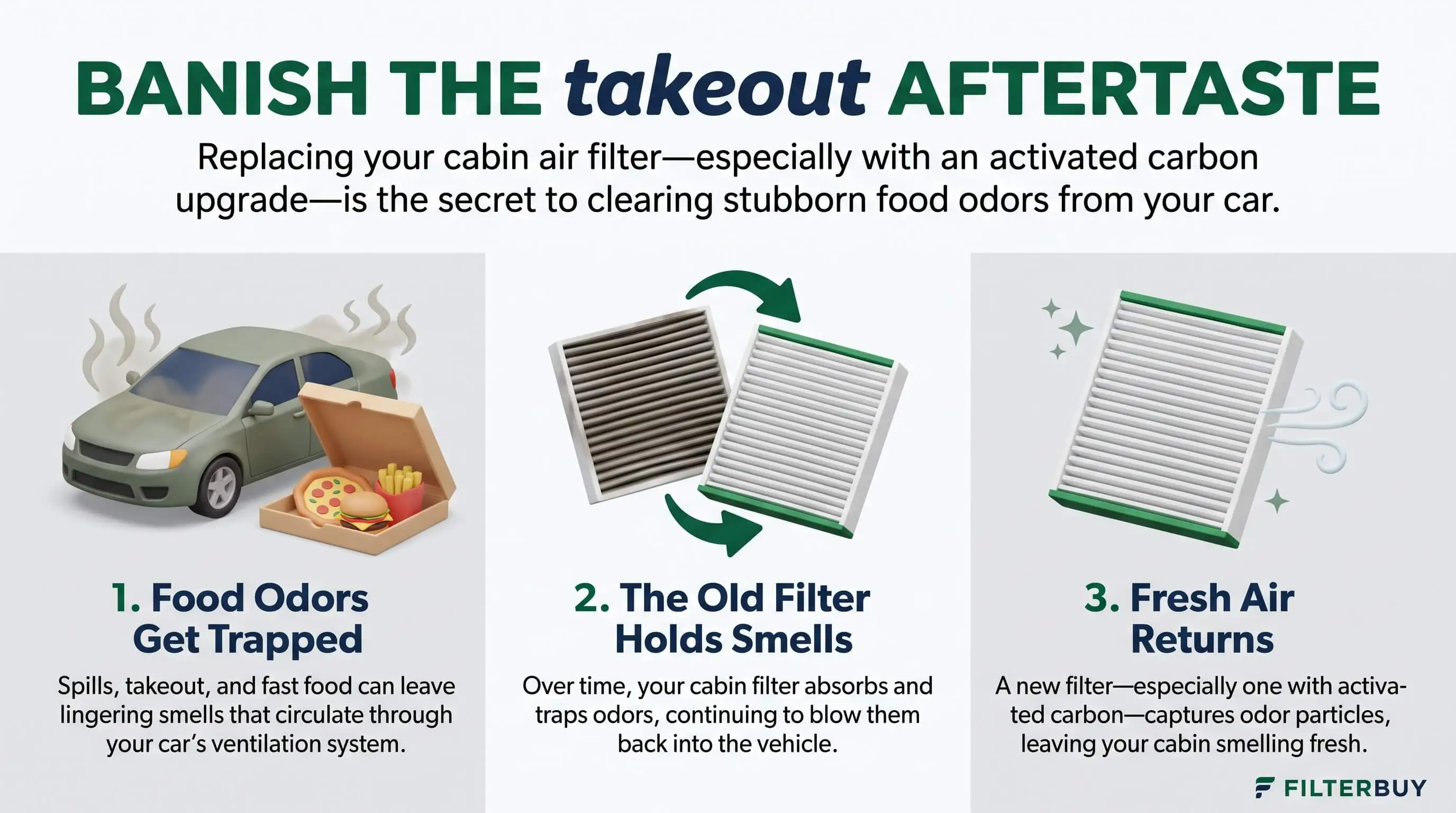
A cabin air filter cleans the air moving through your vents, not the seats and carpet where food odors settle.
Activated carbon filters trap odor molecules. Standard pleated filters only catch particles.
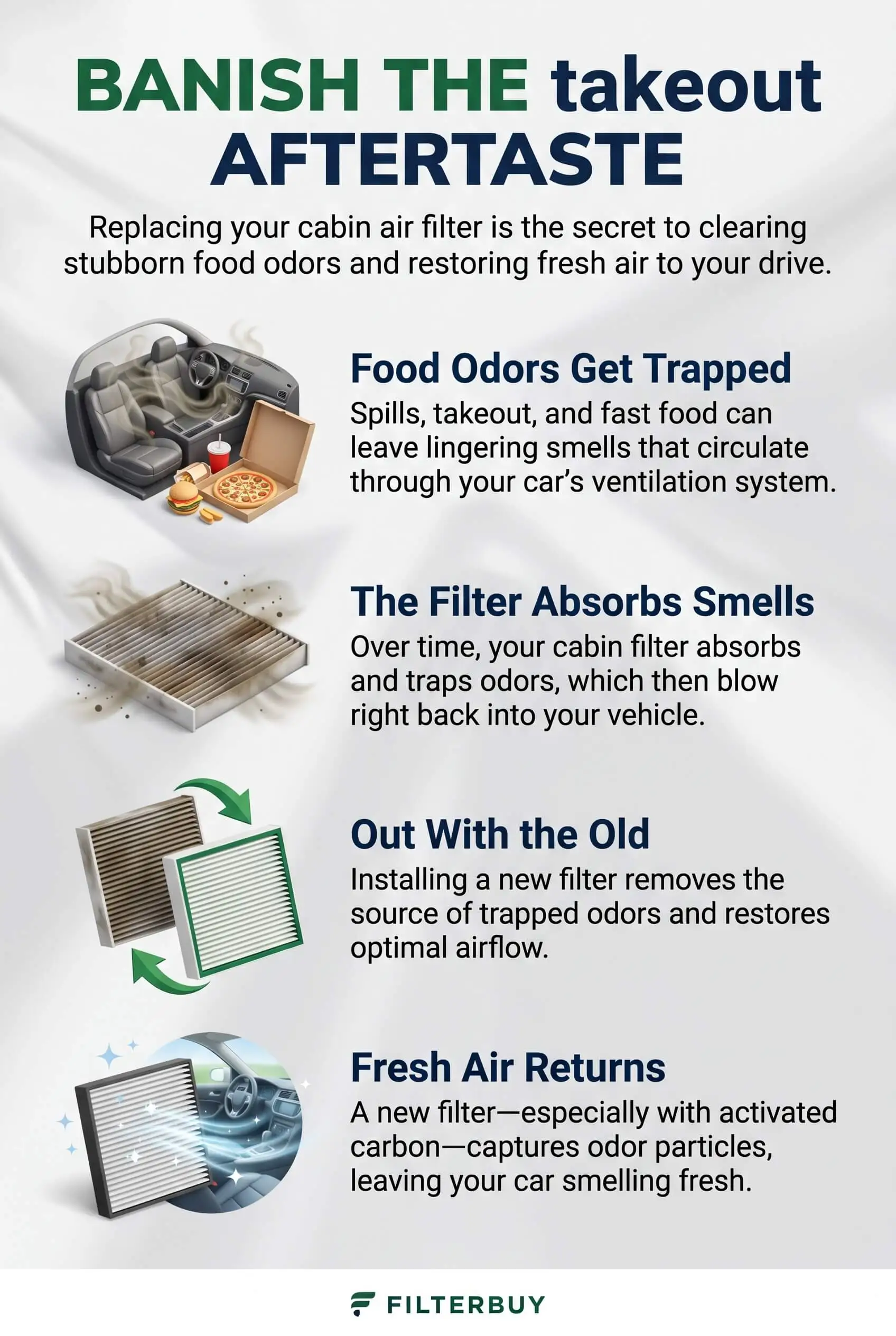
An old, dirty filter can turn into an odor source all by itself.
Clean out the food source first, then replace the filter.
Change the filter every 12,000 to 15,000 miles, and sooner if you eat in the car often.
Where Food Odors Hide in Your Car
Food smells don't hang in the air for long. They sink into surfaces, then drift back out whenever the cabin heats up. Check these spots first.
Seats and carpet. Grease and sauce soak into seat fabric, carpet backing, and floor mats.
The gaps you never vacuum. Seat rails and the slot beside the center console catch crumbs you'll never spot from the driver's seat. Cup holders aren't far behind.
Forgotten food. A bag left under a seat or in the trunk spoils fast in a warm car.
The old filter. A clogged cabin filter holds onto food particles, dust, and moisture until it starts giving off a smell of its own.
The evaporator. A musty, sour smell that only shows up with the A/C on usually means moisture on the evaporator core. The filter isn't the culprit there.
How a Cabin Air Filter Handles Odors
Your cabin air filter usually sits behind the glove box or under the cowl at the base of the windshield. Every bit of air headed for your vents passes through it first. That's its strength and its limit, because a filter can clean the air but never the surfaces around you.
Standard Filters vs. Activated Carbon Filters
A standard pleated filter catches particles like dust and pollen. Odors are gases, so they slip straight through. An activated carbon filter adds a layer packed with tiny pores that grab odor molecules through adsorption, which is why filters with an adsorbent such as carbon can also remove odors and other gaseous pollutants. When food smells are the problem, carbon is the filter that earns its spot.
Fresh-Air Mode vs. Recirculation Mode
Recirculation keeps reusing the air already inside your car. That's useful in stop-and-go traffic when exhaust is thick outside, but it also keeps last night's takeout drifting around the cabin. Many vehicles send recirculated air through the cabin filter too, though the design varies by make and model. Once you've cleaned up, switch to fresh-air mode and push the stale air out.
When Cabin Air Filter Replacement Solves the Smell and When It Won't
A timely cabin air filter replacement makes sense when the vents are part of the problem. Watch for these signs:
The smell gets stronger as soon as the fan kicks on.
Airflow from the vents feels weaker than it used to.
The old filter has crumbs or dark buildup caught in the pleats.
More than a year or 15,000 miles have passed since the last change.
A new filter won't touch the odor if you can still smell it with the fan off or see stains on the upholstery. The same goes for a musty smell that only appears when the A/C is running.
A Step-by-Step Plan to Clear Food Odors
Track down the source. Look under and between the seats, along the seat rails, in the door pockets, and in the trunk.
Clean the soft stuff. Vacuum slowly, then work an enzyme-based upholstery cleaner into any stains.
Wipe down hard surfaces. Give the cup holders, console, and floor mats a good scrub.
Swap in a new cabin air filter. Pick activated carbon, and match the airflow arrow on the new filter to the old one.
Flush the cabin. Run the fan on fresh-air mode with the windows cracked for 10 to 15 minutes.
Check back in a few days. If a musty smell hangs on, the evaporator needs cleaning.
How Often to Replace a Cabin Air Filter for Odor Control
Plan on a fresh cabin filter every 12,000 to 15,000 miles, or about once a year. Change it sooner if your car doubles as a lunch spot, you drive for rideshare or delivery, or kids, pets, and dusty roads are part of your routine. Your owner's manual has the final say on air filter replacement intervals.
"In my experience pulling cabin filters, the ones from cars that double as a lunch table come out with crumbs and a greasy film stuck right on the pleats, and that buildup pushes odor back into the air every time the fan runs. A fresh carbon filter helps, but I always tell drivers to clean the seats and floor first, or the new filter just starts collecting the same smell."
Essential Resources
SAE International: Carbon Adsorption Fundamentals for Cabin Air Applications. The technical groundwork on how activated carbon pulls odors and vapors out of vehicle cabin air.
U.S. EPA: Volatile Organic Compounds' Impact on Indoor Air Quality. Where VOCs come from and how they affect the people breathing them in enclosed spaces.
American Lung Association: Volatile Organic Compounds. Simple ways to cut your VOC exposure, starting with better ventilation.
USDA Food Safety and Inspection Service: How Temperatures Affect Food. Why perishable food spoils so quickly in a warm car, plus safe time limits for leaving it out.
Asthma and Allergy Foundation of America: Mold Allergy. How keeping moisture in check limits the mold behind musty odors.
ASHRAE: Filtration and Disinfection FAQ. How efficiency ratings and airflow shape filter performance, and why a tight seal matters.
FuelEconomy.gov: Keeping Your Vehicle in Shape. Routine maintenance habits that keep your car running the way it should.
Supporting Statistics
On any given day between 2013 and 2016, 36.6% of U.S. adults ate fast food. That's a lot of takeout riding around in cars. CDC National Center for Health Statistics
In a study of professional drivers, a high-efficiency cabin air filter with the windows closed cut in-cabin PM2.5 by 37% and ultrafine particles by 47%. National Library of Medicine (PMC)
The average U.S. driver covers 13,476 miles a year, which lines up almost exactly with a once-a-year filter change. Federal Highway Administration
Final Thoughts and Opinion
Here's my take. A new cabin air filter finishes the job, but it can't start it. Food odors live in the fabric and carpet around you, and no filter reaches them there. Clean first, then swap the filter so the air coming through your vents starts fresh.
If your car regularly doubles as a dining room, spend the little extra on an activated carbon filter. A MERV 11 filter is designed to capture airborne particles in home HVAC systems, while activated carbon helps trap odor molecules instead of letting them slide through, and it helps the rest of your cleanup last longer.
Frequently Asked Questions
Does an Activated Carbon Cabin Air Filter Remove Smells Permanently?
Not permanently. Carbon traps odor molecules until its pores fill up, and after that it stops grabbing new ones. How fast that happens depends on how much smell runs through it. Cleaning out the source and changing the filter on schedule keep it working.
Can a Dirty Cabin Air Filter Make a Car Smell?
Yes. A clogged filter holds onto food particles, dust, and moisture, and your fan pushes air across all of it every time it runs. If the smell is worse with the fan on, start your search at the filter.
Should I Use Recirculation Mode to Keep Food Smells Out?
Not right after you've eaten in the car. Recirculation keeps cycling the same cabin air, so the food smell sticks around longer. Switch to fresh-air mode and crack the windows to clear it out, then save recirculation for heavy traffic or exhaust.
Can I Replace a Cabin Air Filter Myself?
In most vehicles, yes, and it only takes a few minutes. The filter usually sits behind the glove box or under the cowl and slides out, often without tools. Note which way the airflow arrow points on the old filter and install the new one the same way.
Why Does My Car Still Smell Like Food After a New Filter?
The source is probably still in the car. Check under the seats, along the seat rails, and in the trunk, then work an enzyme cleaner into the upholstery. If the smell is musty and only shows up with the A/C, look at the evaporator instead.
Clear the Food Smell for Good
You're the one who keeps this car fresh for everyone riding in it, and food odors leave for good once you clean out the source and finish with a fresh activated carbon cabin air filter. Check your mileage and your filter's condition, then plan the AC air filter replacement that keeps every drive smelling clean.