This page cuts through the noise: the specific MERV ratings that outperform for pet dander, the media characteristics that matter, and the replacement intervals that keep capture rates high — all based on what we know from the filter out, not the marketing copy on the box.
TL;DR Quick Answers
20x20x1 Air Filter
A 20x20x1 air filter is one of the most common residential HVAC filter sizes in the U.S. Here is what to know before you buy:
Actual size is 19.5 x 19.5 x 0.75 inches — the 20x20x1 is the nominal ordering size
Best MERV rating for most homes is MERV 11 — captures particles as small as 1 micron including pet dander, pollen, and mold spores without restricting airflow in standard systems
Replacement interval is every 90 days for average households, every 45 to 60 days for pet households, and every 30 days for multi-pet or allergy households
Media construction matters — electrostatically charged synthetic media outperforms fiberglass at the same MERV rating, particularly against fine particulate
Made in the USA — FilterBuy manufactures 20x20x1 filters domestically across MERV 8, MERV 11, MERV 13, and Odor Eliminator ratings, ships within 24 hours, and sells directly from the factory — no distribution markup
The right 20x20x1 filter paired with the right replacement schedule is the single most effective step most households can take to improve indoor air quality.
Top Takeaways
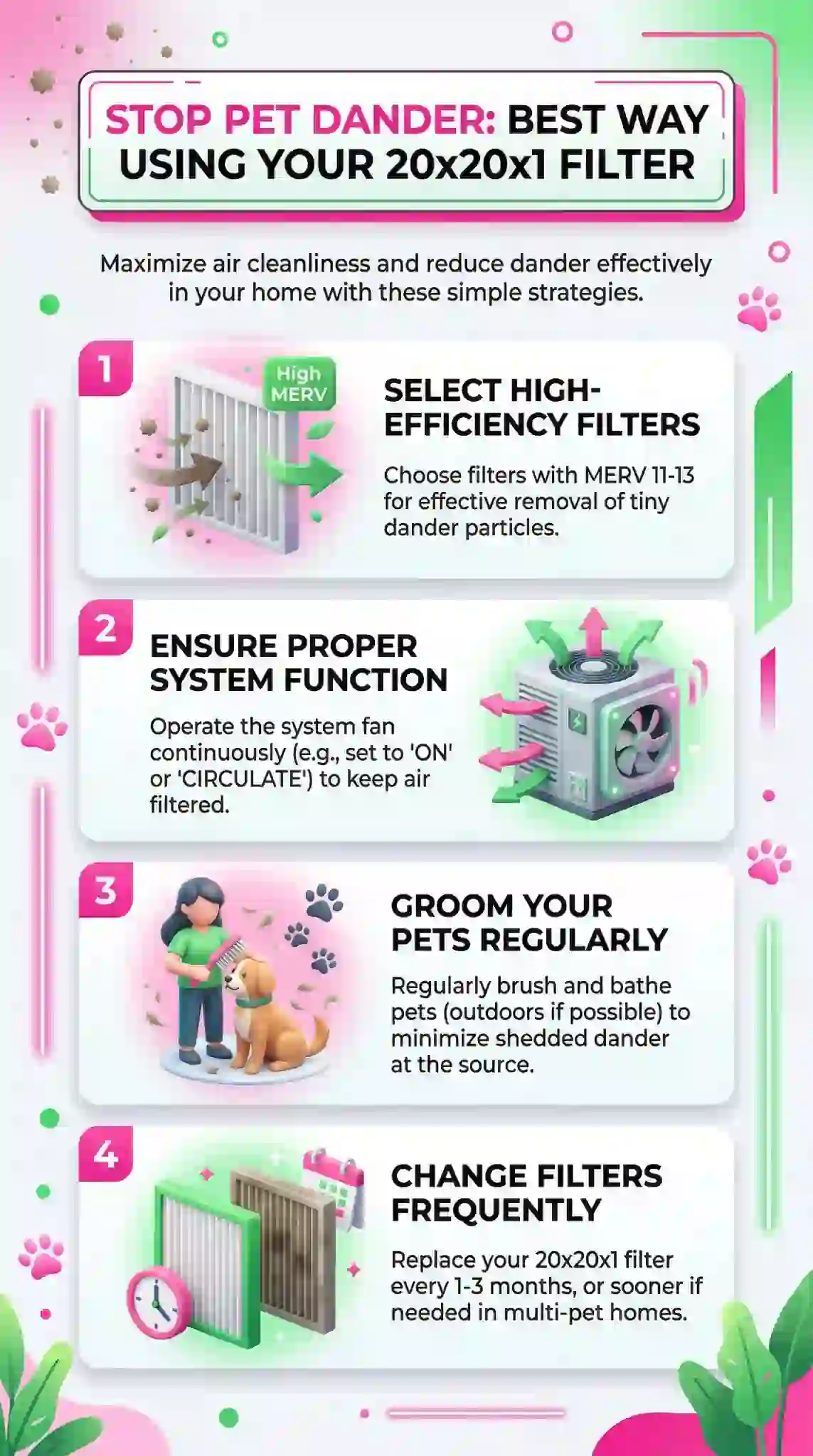
MERV 11 is the sweet spot for pet households. Captures particles as small as 1 micron. Effective against dander. Compatible with standard residential HVAC systems.
Media construction matters as much as MERV rating. Electrostatically charged synthetic media intercepts dander. Fiberglass at the same rating underperforms. The number on the frame only tells part of the story.
The 90-day replacement standard wasn't written for pet homes. Replace every 45 to 60 days in single-pet households. Every 30 days in multi-pet homes or allergy households. An overloaded filter stops capturing and starts bypassing.
Pet dander doesn't stay where your pet does. Per the NIEHS, allergens circulate in air and cling to surfaces for months. Your HVAC system either contains that load or redistributes it. The return vent filter is the primary interception point.
The filter is one part of the solution — not the whole system. Three habits that reduce the load on your filter:
Vacuum with a HEPA-equipped vacuum two to three times per week
Brush pets outdoors to limit the initial dander load
Keep bedroom doors closed to restrict dander migration into sleeping areas
Why Pet Dander Is Harder to Filter Than Most People Think
Pet dander isn't just pet hair. It's microscopic flakes of skin — typically between 2.5 and 10 microns — that stay airborne for hours and cling to surfaces long after your pet leaves the room. Standard low-MERV filters are designed to catch large debris like dust and lint, not the fine particulate that triggers allergic reactions. That gap in filtration is where most pet owners lose the battle with indoor air quality without ever realizing it.
The MERV Rating That Actually Makes a Difference for Pet Owners
For pet dander, MERV 11 is the practical sweet spot in a 20x20x1 filter. It captures particles as small as 1 micron — well within the dander range — without creating the airflow restriction that higher MERV ratings can impose on residential HVAC systems not built for dense filtration media. MERV 8 filters will catch some dander, but their capture efficiency drops significantly at the sub-3-micron range where the most allergenic particles live. MERV 13, while effective, can reduce airflow enough in standard systems to cause long-term wear on the blower motor. For most pet households, MERV 11 delivers the best balance of capture performance and system compatibility.
How Filter Media Construction Affects Dander Capture
Not all MERV 11 filters perform equally. Media construction — specifically fiber density and electrostatic charge — determines how effectively a filter intercepts fine particles rather than just blocking them mechanically. Electrostatically charged synthetic media attracts dander particles the way a magnet attracts metal shavings, pulling them out of the airstream even when they're too small to be physically blocked by the fiber matrix. Filters built on fiberglass media at the same MERV rating consistently underperform on fine particulate because the fiber structure is too coarse for reliable dander interception. The filter's construction tells you as much about its real-world performance as its MERV rating does.
The Replacement Schedule Pet Owners Actually Need
A filter working hard against pet dander loads up faster than one in a pet-free home. In single-pet households, a 20x20x1 filter should be replaced every 45 to 60 days — not the 90-day interval printed on most packaging, which assumes average household conditions. In homes with multiple pets, heavy shedding breeds, or occupants managing pet allergies, 30-day replacement cycles are more realistic. An overloaded filter doesn't just stop capturing dander — it becomes a resistance point that forces your HVAC system to work harder while bypassing particles around the filter edges. Staying ahead of the replacement schedule is the single most overlooked variable in pet dander control.
Supporting Your Filter With a Few Simple Habits
Even the best 20x20x1 filter performs better when paired with consistent housekeeping. Vacuuming with a HEPA-equipped vacuum two to three times per week reduces the volume of settled dander that gets re-suspended into your airstream every time your HVAC cycles on. Brushing pets outdoors instead of inside keeps the initial dander load lower before it ever reaches the filter. Keeping bedroom doors closed during the day limits dander migration into the spaces where air quality matters most. None of these replace filtration — they reduce the burden on your filter and extend its effective capture window between replacements.
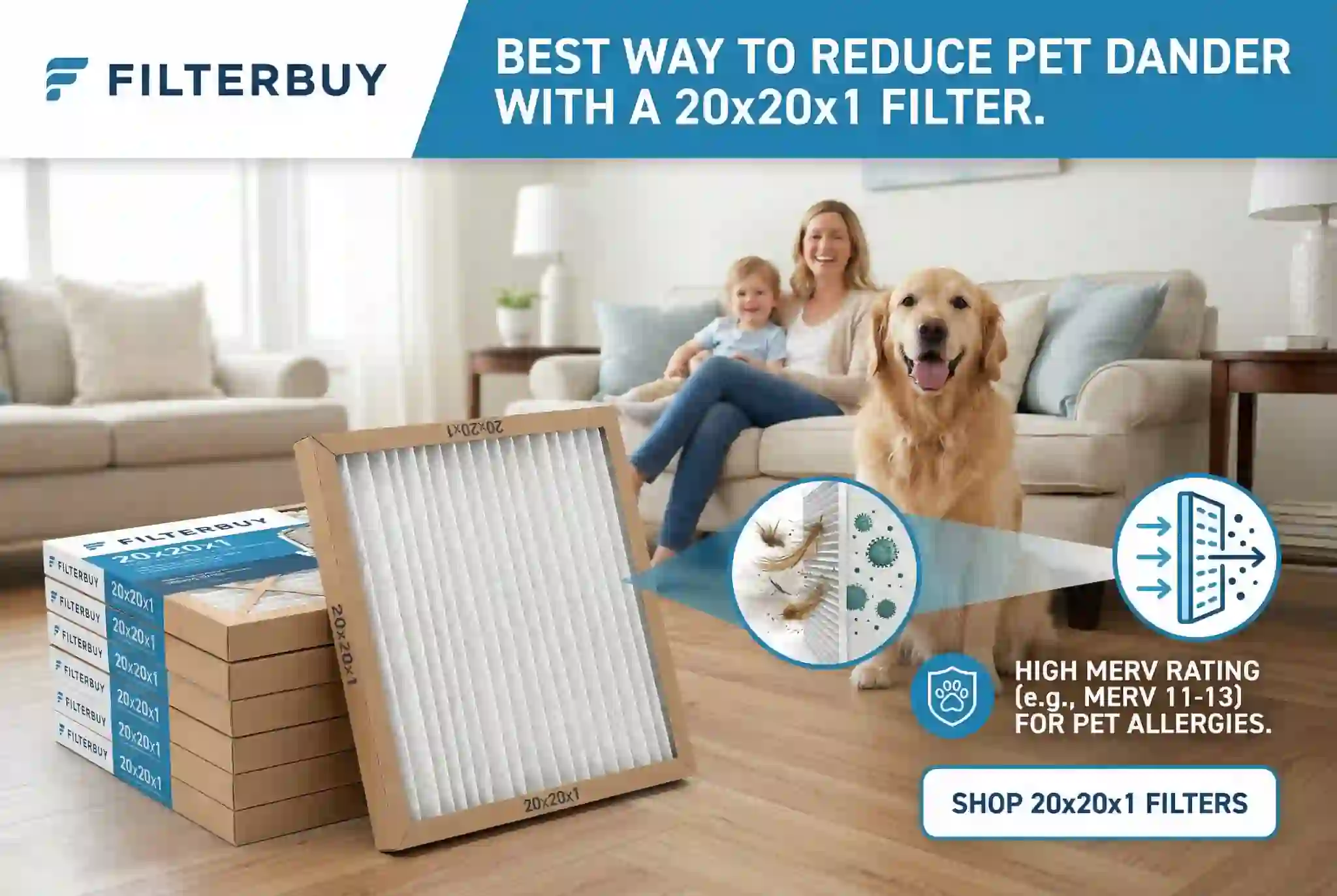
"We've processed the data from millions of filter returns, and the pattern is consistent — pet households running MERV 8 filters are replacing them on schedule and still wondering why their allergy symptoms haven't improved. The filter rating looks right on paper, but the particle capture efficiency at the 1-to-3-micron range just isn't there. Dander doesn't care what the packaging says. It only responds to what the media can actually intercept."
Essential Resources
Start Here: The EPA's Official Word on MERV Ratings
If you're choosing a 20x20x1 filter for pet dander and you're not sure what MERV means, this is the one resource to read first. The EPA breaks down exactly how filters are rated, what particle sizes each rating captures, and why that number determines whether your filter actually works for your household. https://www.epa.gov/indoor-air-quality-iaq/what-merv-rating
How Your HVAC Filter Performs Against Cat and Dog Allergens — Per the EPA
This EPA guide goes beyond ratings and looks at real-world filter performance against specific particles — including cat and dog allergens. One finding worth knowing before you buy: filters rated MERV 7 to 13 can be nearly as effective as HEPA for controlling most airborne indoor particles, at a fraction of the cost and airflow restriction. https://www.epa.gov/sites/default/files/2014-07/documents/aircleaners.pdf
Why Pet Dander Doesn't Stay Where Your Pet Does
Pet dander doesn't settle where your pet sleeps — it moves through your HVAC system and redistributes through every room. The EPA's biological pollutants resource explains exactly how that spread happens and what it means for the filter decisions you make at the return vent. Understanding the problem makes the solution clearer. https://www.epa.gov/indoor-air-quality-iaq/biological-pollutants-impact-indoor-air-quality
The Filter Recommendation Allergy Specialists Stand Behind
The American College of Allergy, Asthma and Immunology recommends disposable filters rated MERV 11 to 13 as the most cost-effective whole-home solution for pet allergen households. We manufacture across that entire range — this resource explains the clinical reasoning behind why those ratings work. https://acaai.org/allergies/management-treatment/living-with-allergies/air-filters/
Before You Upgrade Your MERV Rating, Read This
Choosing a higher MERV filter is the right call for most pet households — but your HVAC system needs to be able to handle it. The Department of Energy's Building America resource covers the airflow resistance and static pressure variables that determine whether a MERV upgrade helps your system or works against it. https://basc.pnnl.gov/resource-guides/high-merv-filters
What the Research Actually Shows About Pet Allergen Filtration
This peer-reviewed NIH clinical study measures the real impact of HVAC filtration on airborne pet allergen levels — including what filtration can and can't do. It's the kind of data we pay attention to when we're manufacturing filters designed to perform in pet households, not just pass a spec sheet. https://pmc.ncbi.nlm.nih.gov/articles/PMC5763515/
FilterBuy's Guide to Choosing the Right MERV Rating for Your Home
We built this resource from the manufacturing side — not the marketing side. It covers MERV selection by household type, system compatibility, and allergen-specific performance characteristics based on what we know from producing millions of filters. Use it alongside the references above to make the call with confidence. https://filterbuy.com/resources/air-filter-basics/which-merv-rating-should-I-use/
Supporting Statistics
We've seen the data from both sides — clinical research and real-world filter return patterns. These three statistics explain what we observe consistently across pet households. They're not just numbers. They're the reason pet homes need a different filter strategy than everyone else.
Stat 1: 6 in 10 U.S. Homes Have a Pet — and About 30% of Those Residents Are Allergic to Them
Allergies to cats and dogs affect an estimated 10 to 20 percent of the world's population. Most of those people still have pets. From a filtration standpoint, that gap matters.
What we see in the order data:
Pet households running MERV 8 filters on a 90-day schedule
Occupants still experiencing symptoms
No change in filter strategy — just repeated purchases of the wrong rating
The MERV 8 / 90-day combination doesn't work for a home with an active daily dander load. That's one of the clearest gaps between what packaging implies and what a pet household actually needs.
Source: Asthma and Allergy Foundation of America (AAFA) https://aafa.org/allergies/types-of-allergies/pet-dog-cat-allergies/
Stat 2: Americans Spend About 90% of Their Time Indoors — Where Pollutant Levels Run 2 to 5 Times Higher Than Outside
Indoor pollutant concentrations regularly run 2 to 5 times higher than outdoor levels. Dander your system doesn't capture on the first pass and doesn't leave the building. It recirculates.
What this means for filter construction:
Fiber density determines whether dander is intercepted or bypassed
Electrostatic charge pulls fine particles out of the airstream between fibers
MERV rating alone doesn't tell the full performance story — media construction does
A filter processing recirculated air in a closed pet household is under a different load than one spec'd for average conditions, especially in environments influenced by air conditioning. We build for that load
Source: U.S. Environmental Protection Agency — Indoor Air Quality https://www.epa.gov/report-environment/indoor-air-quality
Stat 3: Pet Allergens Can Linger in Your Home for Months — Even After the Pet Is Gone
Pet allergens circulate in air and remain on carpets and furniture for months. They travel on clothing into spaces where no pet has ever been. Persistence is the defining characteristic of pet dander — and it's why replacement interval is as important as MERV rating.
What happens when a pet household runs past the 90-day mark:
Filter media becomes saturated with dander, hair, and particulate
Airflow reroutes around the frame edges instead of through the media
Capture efficiency drops — the filter is no longer doing its job
The HVAC system works harder to compensate
45 to 60 days keeps the media ahead of the load. 90 days puts the load ahead of the media.
Source: National Institute of Environmental Health Sciences (NIEHS) — Pet Allergens https://www.niehs.nih.gov/health/topics/agents/allergens/pets
Final Thought & Opinion
Most pet owners focus on choosing the right filter. After manufacturing millions of them, we'd argue the more important decision is understanding why the right filter works — and what happens when it's pushed past its limits.
What the production side has taught us:
A MERV 11 filter isn't just a better MERV 8. It's a categorically different tool built for the particle size range where dander actually lives.
Media construction separates filters that intercept dander from filters that merely slow it down. That distinction doesn't show up on the packaging.
The 90-day replacement standard was never written for pet homes. It was written for average households.
An overloaded filter doesn't hold its position — it surrenders it. Air bypasses the media entirely.
Most pet households aren't suffering from a bad filter choice. They're suffering from the right filter managed on the wrong schedule with the wrong expectations.
Our Recommendation — Based on What We See Across Millions of Filter Cycles
Choose MERV 11 as your baseline. Not MERV 8 because it's cheaper. Not MERV 13 unless your system is spec'd for it.
Treat 45 to 60 days as your replacement ceiling. Check the filter for 30 days. The media will tell you what the calendar won't.
Treat the filter as one part of a system. What the filter captures, consistent habits keep from re-entering the airstream.
Pet dander is a chronic load, not a seasonal one. The filters that work best in pet homes aren't always the ones with the highest rating — they're the ones paired with the right interval and the right habits.
FAQ on 20x20x1 Air Filter
Q: What does 20x20x1 mean on an air filter?
A: It's the nominal size — the labeled ordering dimension, not the exact physical measurement. The actual size runs closer to 19.5 x 19.5 x 0.75 inches. That gap is intentional. After producing filters across hundreds of sizes, we know what happens when that tolerance is ignored:
Bowed frames
Gapped seals
Air bypassing the media entirely
Order from the nominal size printed on your current filter's frame. Don't measure the slot.
Q: What MERV rating should I choose for a 20x20x1 filter in a home with pets?
A: MERV 11 — and we'd say that even if we sold every rating equally. Here's why:
MERV 8 loses efficiency below 3 microns — exactly where the most allergenic dander particles live
MERV 13 creates airflow resistance most standard residential systems weren't designed to handle long-term
MERV 11 captures particles as small as 1 micron and fits within the airflow tolerance of virtually every residential HVAC system we've seen it installed in
Check your system manual for its maximum rated MERV before going higher.
Q: How often should I replace a 20x20x1 air filter in a home with pets?
A: More often than the box says. The 90-day interval was never designed for pet households. What we see consistently: pet household filters are visibly loaded well before the 90-day mark.
Replacement intervals by household type:
Single-pet household — every 45 to 60 days
Multi-pet household — every 30 days
Allergy or asthma household with pets — every 30 days or sooner
Pull the filter at 30 days and look at it. The media will tell you more than the calendar will.
Q: Will a 20x20x1 air filter alone solve my pet dander problem?
A: It handles the airborne load your HVAC system processes — which is significant. But a filter only captures what passes through it. Settled dander re-enters circulation between HVAC cycles from:
Foot traffic stirring surface particles back into the air
Indoor grooming releasing fresh dander directly into the room
Vacuuming without a HEPA-equipped machine
Three habits that extend your filter's effective capture window:
Groom pets outdoors to reduce the initial dander load
Vacuum with a HEPA-equipped vacuum two to three times per week
Keep pets out of sleeping areas to limit overnight dander migration
The filter is your primary defense. These habits reduce what it has to defend against.
Q: Are all 20x20x1 air filters the same quality at the same MERV rating?
A: No — and this is the question most filter buyers never think to ask. MERV rating is a performance threshold, not a construction standard. Two MERV 11 filters can be built completely differently and perform very differently against pet dander.
What separates filters at the same MERV rating:
Media type — electrostatically charged synthetic media outperforms fiberglass in the 1-to-3-micron dander range at the same rated efficiency
Frame integrity — a frame that flexes under HVAC static pressure creates bypass gaps that make the media rating irrelevant
Construction consistency — buying directly from the manufacturer means the construction behind the rating is the construction you actually get
The MERV number tells you the threshold. The construction determines whether the filter actually hits it.
Ready to Reduce Pet Dander With the Right 20x20x1 Filter?
We manufacture MERV 11 20x20x1 filters built specifically for the particle size range where pet dander lives — shipped directly from our facility to your door in 24 hours. Shop our 20x20x1 filter lineup and find the right MERV rating for your household today.